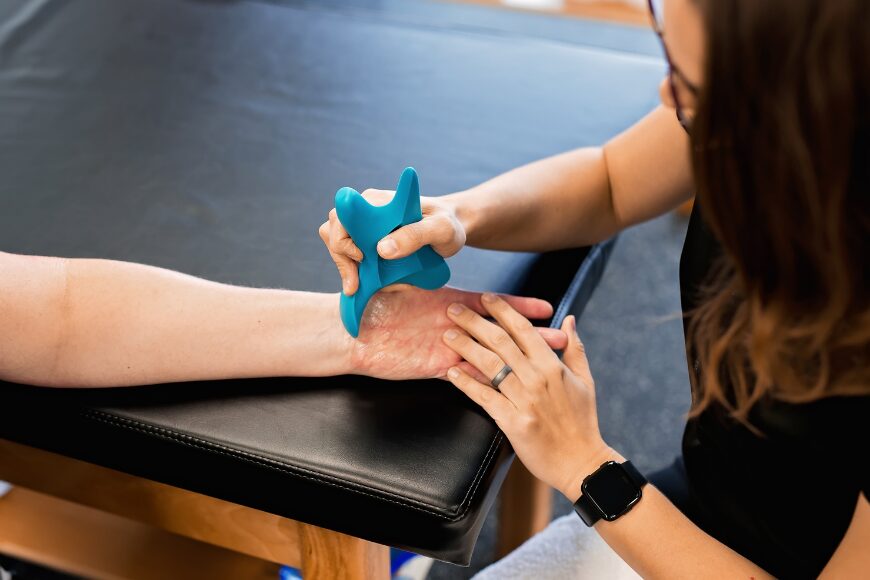
Golfer’s Elbow Treatment Byrnes Mill, MO. Whether you’re an avid golfer, spend long days using tools at work, or simply noticed pain on the inside of your elbow after repetitive activity, golfer’s elbow can make everyday tasks surprisingly difficult and uncomfortable.
The good news is that most cases of golfer’s elbow improve without surgery or injections. At Axes Physical Therapy in Byrnes Mill, MO, we create personalized treatment plans to reduce pain, restore strength, and address the factors contributing to your injury. Our main focus is to get you back to the activities you love and help you return to work, sports, and daily activities with confidence.
For many patients in Byrnes Mill, MO, Axes can be the first call rather than the last stop. Missouri’s direct access law may let you start physical therapy without seeing a physician first, with appointments commonly available one or two days after you reach out.
Your next step can be an appointment, a phone call, or a screening. Schedule online, reach out to the nearest location, or visit us for a free injury screening.
If your elbow pain begins after an acute injury, causes severe swelling or deformity, limits movement, or is accompanied by numbness, tingling, or weakness, seek medical evaluation promptly.
This page covers:
- The connection between repetitive arm use and the development of golfer’s elbow
- How golfer’s elbow is diagnosed through a physical exam and movement testing
- The role of physical therapy in easing pain, restoring motion, and rebuilding capacity
- What can make golfer’s elbow less likely to return after symptoms improve
Golfer’s Elbow Explained
The tendons involved in golfer’s elbow attach forearm muscles to the bony point on the inner side of the elbow. Doctors call the condition medial epicondylitis. Those same muscles power gripping, wrist bending, and forearm rotation.
The problem builds when tendon stress keeps arriving faster than the tissue can recover. Small areas of damage may accumulate, and the result can be weakness, reduced function, and pain centered at the inner elbow or extending into the forearm.
The name points to a sport, not a requirement. Plumbers, climbers, weightlifters, musicians, and many others can develop golfer’s elbow when their usual activities repeatedly load the forearm and wrist.
What Inner-Elbow Tendon Irritation Can Feel Like
One sudden injury is not the usual story. Symptoms tend to build in the background, with occasional soreness gradually turning into a problem that is harder to ignore.
Common symptoms include:
- Pain or tenderness along the inside of the elbow
- Gripping, lifting, and twisting movements that bring the pain on
- Weak grip strength
- Reduced comfort or motion when you first move after rest
- Pain when making a fist or bending the wrist
- Everyday hand tasks, from jars to shopping bags, become difficult
- Occasional pins-and-needles in the ring and little fingers when irritation spreads to surrounding nerves
Because many of these symptoms can overlap with other elbow conditions, receiving an accurate golfer’s elbow diagnosis in Byrnes Mill, MO is the first step toward finding the right treatment.
Why Golfer’s Elbow Develops
Golfer’s elbow develops when repetitive stress exceeds the tendon’s ability to recover. Instead of healing fully between activities, the tendon experiences ongoing strain that gradually leads to pain and dysfunction.
Sports That Load the Inner Elbow
The same forces found in a golf swing appear in plenty of other activities. Sports that repeatedly load the forearm and inner elbow include:
- Baseball and softball
- Tennis and other racquet sports
- Weightlifting
- Rock climbing
- Bowling
Three common accelerants are poor mechanics, mismatched equipment, and doing too much too soon. Each one increases the force or repetition the tendon must absorb.
Work-Related Activities
Many occupations require repetitive gripping or forceful wrist movements throughout the day, increasing the likelihood of developing golfer’s elbow.
People working in construction, plumbing, electrical work, manufacturing, landscaping, carpentry, automotive repair, and warehouse jobs commonly experience this type of overuse injury.
The condition may also develop when someone suddenly takes on more physically demanding work than their body is prepared to handle.
Everyday Activities
No gym, jobsite, or playing field is required. Hours spent on a home project, practicing music, working in the garden, carrying heavy items, or repeating a fine-motor task can be enough to irritate the tendon.
Often there is no single culprit. Work, exercise, chores, and hobbies may each add a little stress until the combined workload becomes too much.
Who Has a Higher Risk of Golfer’s Elbow in Byrnes Mill, MO?
The condition can affect almost anyone, but your risk rises when the tendon faces more stress or has less support. Common factors include:
- Suddenly increasing activity levels
- Poor lifting or sports mechanics
- Weakness or limited flexibility in the forearm and shoulder
- Previous elbow injuries
- Tools or sports gear that force the arm to work harder than necessary
- Skipping rest while performing the same hand or wrist motion
- Being over 40, when tendons may be less forgiving of sudden overload
These factors are not just clues about how the injury started. Improving them can also make recovery more durable and reduce the odds of repeating the same cycle.
How Is Golfer’s Elbow Diagnosed in Byrnes Mill, MO?
The evaluation begins with your story: when the pain started, which activities provoke it, what your work or hobbies demand, and whether you have had related injuries before. A physical exam follows.
A golfer’s elbow evaluation in Byrnes Mill, MO looks at more than where it hurts. Your provider may also test how well your elbow and wrist move, measure your grip strength, and see which motions bring the pain back.
X-rays or MRI scans are not always necessary. However, your Byrnes Mill, MO provider may recommend additional testing if they suspect another condition, such as a ligament injury, arthritis, nerve compression, fracture, or tendon tear.
A thorough evaluation also helps identify the movement patterns, muscle imbalances, or activity habits contributing to your pain so treatment addresses more than just the symptoms.
How Golfer’s Elbow Physical Therapy Works in Byrnes Mill, MO
Pushing through the pain may turn a manageable irritation into a longer recovery. Early treatment often starts by identifying the aggravating activity and scaling it back long enough for symptoms to calm down.
A brief period of rest and activity modification may help calm your symptoms, but rest alone does not always prepare the tendon to handle work, sports, exercise, or everyday activities again. Once the initial pain begins to improve, physical therapy can help you gradually rebuild strength, restore movement, and address the factors that contributed to the injury.
At Axes, your personalized treatment plan is based on your symptoms, goals, occupation, hobbies, and activity level. Rather than following a one-size-fits-all program, your Byrnes Mill, MO physical therapist will adjust treatment as your elbow’s function and comfort improve.
Reducing Pain and Restoring Movement
Early sessions may combine temporary activity changes with manual therapy, gentle mobility work, and other methods that make movement more comfortable while the tendon settles.
Rather than banning every painful activity, your Byrnes Mill, MO physical therapist can look for the part that is driving the stress. A looser grip, different lifting setup, posture change, equipment adjustment, or temporary workload reduction may be enough to protect the tendon.
If appropriate, treatment may also include dry needling to address muscle tension and improve function.
The elbow does not move in isolation. If the wrist, forearm, shoulder, or elbow itself is restricted, other tissues may compensate and increase the strain. Stretching and mobility exercises can help restore a smoother chain of movement.
Building Tendon Capacity Again
Pain often improves before strength fully returns. Progressive strengthening closes that gap, gradually teaching the tendon to tolerate the gripping, lifting, throwing, and swinging forces it will face outside the clinic.
Your strengthening plan may use:
- Grip-strengthening exercises
- Forearm and wrist strengthening
- Isometric exercises
- Eccentric tendon-loading exercises
- Exercises that improve strength above the elbow
- Functional exercises that recreate the tasks your job, sport, or routine requires
Progression is the engine of the program. As your strength improves, your Byrnes Mill, MO physical therapist adds carefully measured challenge so the tendon adapts without being thrown straight back into overload.
Your therapist may send you home with a short list of exercises matched to your stage of recovery. Consistent follow-through can preserve gains, build strength, and keep momentum moving between visits.
Treating the Entire Arm
Treating only the sore spot can miss part of the story. The wrist, hand, shoulder, and upper back all influence how much work reaches the inside of the elbow.
The forearm often picks up the slack when another link is weak. By checking shoulder strength, wrist mobility, lifting mechanics, and coordination through the upper back and hand, your therapist can see where the extra elbow stress begins.
When the arm shares force more efficiently, the injured tendon gets support from the entire chain. That can improve recovery now and make future symptoms less likely.
Changing the Movements That Keep Irritating It
Treatment may follow you into the movements that matter most: a golf swing, a throw, a lift, tool handling, desk setup, or the way you carry an object. Your Byrnes Mill, MO physical therapist can break those tasks down and adjust the stressful pieces.
Golfer’s elbow may be related not only to how often you perform an activity, but also to how you perform it. Gripping too tightly, bending the wrist excessively, using poorly fitted equipment, or lifting with inefficient mechanics can repeatedly overload the tendon.
The best adjustment is one you can actually use. By studying your real work, sport, and daily tasks, your Byrnes Mill, MO physical therapist can recommend practical changes that lower strain without disconnecting you from the activities that matter.
Turning Clinic Gains Into Real-World Function
Early rehabilitation builds a foundation. Later rehabilitation tests that foundation against the movements you actually need, increasing specificity as your strength and mobility return.
Your therapist can recreate the building blocks of your routine in a safer setting, from carrying and lifting to throwing, gripping, swinging, and handling equipment.
The goal is to help you return to the activities you need and enjoy with enough strength and confidence to reduce the risk of another flare-up.
As you return to work, sports, or other activities, your therapist may also recommend supportive techniques such as Kinesio taping® to help improve comfort, provide proprioceptive feedback, or reduce strain during movement.
How Long Does It Take to Recover from Golfer’s Elbow?
Recovery varies from person to person depending on how long symptoms have been present, the severity of the injury, and how consistently treatment recommendations are followed.
Some people begin feeling better within a few weeks, while others with longstanding or more severe symptoms may require several months of rehabilitation.
Factors that may affect recovery include:
- How long the tendon stayed irritated before you sought help
- How much the painful activity can be reduced or changed during recovery
- The force and repetition required by your work or athletic activity
- How deconditioned or weakened the involved tissue has become
- Whether another part of the upper extremity is contributing to the overload
- How consistently you complete your exercises
- How soon you ask the tendon to handle its previous workload
A tendon that feels better may still be rebuilding. Returning to repetitive activity before it has enough capacity can restart the irritation, which is why your therapist’s progression matters even after pain begins to fade.
Preventing Golfer’s Elbow in Byrnes Mill, MO
While not every case can be prevented, reducing repetitive stress and improving overall strength can significantly lower your risk of future problems.
Helpful prevention strategies include:
- Increase volume or intensity in steps the arm can absorb
- Using proper technique during sports, exercise, and lifting
- Start demanding activity after the muscles and joints are moving comfortably
- Use planned pauses instead of waiting until the elbow is already irritated
- Avoid squeezing harder than necessary during tools, sports, or carrying
- Strengthen the muscles that help distribute load across the arm
- Keep flexibility and mobility from becoming another source of compensation
- Replace poorly fitted or unnecessarily heavy tools and gear
- Leave enough space between demanding sessions for recovery
- Treat small warning signs as a cue to adjust, not something to ignore
After recovery, a maintenance program can preserve the strength and load tolerance you worked to rebuild. A small amount of consistent training may help keep future flare-ups from gaining traction.
Support for Your Golfer’s Elbow Recovery in Byrnes Mill, MO
Axes starts with the person rather than a preset protocol. The advantages of choosing our team include:
- Personalized treatment plans: The program is shaped around the symptoms you feel, the goals you set, and the demands of your work and lifestyle.
- Less time waiting: We can usually get new patients onto the schedule within 24 to 48 hours.
- Direct Access: Many Missouri patients can begin physical therapy without waiting weeks for a physician referral.
- Coordinated referrals: If your symptoms point to care outside physical therapy, we can help connect you with an appropriate provider.
- Free injury screenings: If you are unsure where to begin, a free injury screening can help you better understand your symptoms and next steps.
Other treatment’s we offer in Byrnes Mill, MO include:
- Runner's Knee Pain Treatment
- Frozen Shoulder Treatment
- Trigger Finger Treatment
- Shoulder Pain Treatment
- Back Pain Treatment
- Neck Pain Treatment
- Physical Therapy Clinic
- Carpal Tunnel Syndrome Treatment
- Sciatica Treatment
Frequently Asked Questions About Golfer’s Elbow Treatment in Byrnes Mill, MO
Can rest alone make golfer’s elbow go away?
Mild cases may improve with rest and activity changes. If pain lasts more than a few weeks or affects daily life, physical therapy can help restore strength and function.
How long does golfer’s elbow take to heal?
There is no single number. A newer irritation with modifiable activities may improve relatively quickly; a longstanding problem tied to heavy work or sports usually takes longer to rebuild.
How can I keep working while my elbow heals?
The answer depends on what your job asks the arm to do. Instead of stopping work completely, you may be able to reduce the most irritating demands and rebuild tolerance in stages with guidance from your therapist.
When should I use heat or ice for golfer’s elbow?
Use them for different jobs: ice may ease soreness after an aggravating activity, while heat can make tight muscles feel more comfortable before movement. Neither one restores tendon strength or replaces rehabilitation.
When is a brace useful for golfer’s elbow?
A brace may reduce strain during certain activities, but it does not fix the underlying problem. Your therapist can tell you whether one may help.
What activities should I avoid with golfer’s elbow?
Avoid activities that clearly worsen your pain, especially heavy lifting, repetitive gripping, and forceful wrist movements. Your therapist can help you modify them safely.
Can rehabilitation reduce the chance that I need surgery?
In many cases, yes. Physical therapy can reduce pain, rebuild strength, improve mobility, and address the movements contributing to the injury.
Do I need a doctor’s referral for physical therapy?
A physician referral is not required for many people in Missouri. You can often start with physical therapy, and the Axes team can direct you elsewhere if the findings call for additional medical attention.
How long should I wait before seeing a physical therapist?
Schedule an evaluation if pain lasts more than a couple of weeks, worsens, or limits work, exercise, or daily activities. Seek care sooner for numbness, weakness, swelling, or pain after an injury.
Begin Golfer’s Elbow Treatment in Byrnes Mill, MO
Persistent elbow pain does not have to set the limits for your work, recreation, or daily routine.
Golfer’s elbow can interrupt many different lives for the same reason: the tendon no longer tolerates what you need it to do. The Axes Physical Therapy team is here to help restore that capacity and get you moving forward again.
Choose your starting point: request an appointment online, call the Axes location nearest you, or use a free injury screening to get clearer direction.