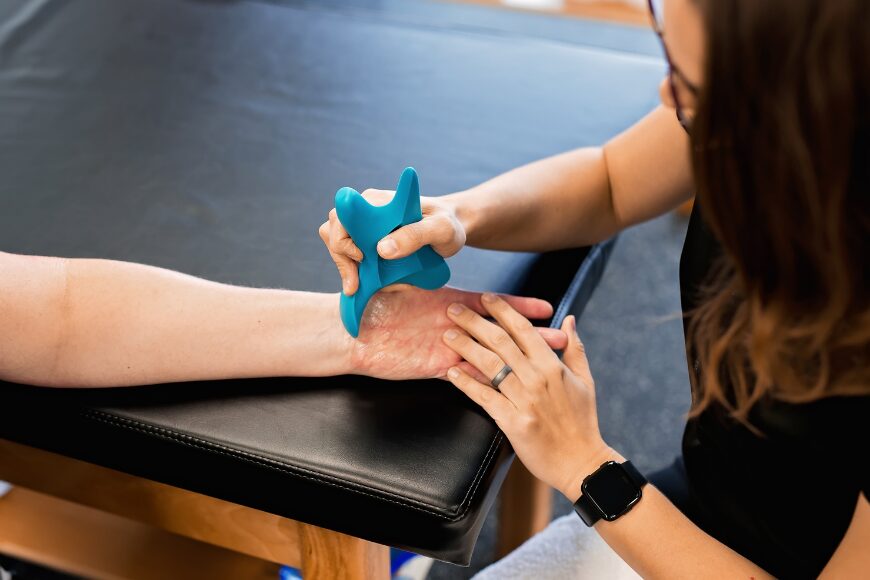
Trigger finger treatment in Dittmer, MO can help when pain, stiffness, catching, or locking starts making your finger or thumb feel unreliable during everyday use.
A finger that sticks or locks can turn small tasks into a daily nuisance. Buttoning clothes, using a phone, gripping a steering wheel, lifting at work, holding a racket, or opening containers may start to require more effort than they should.
The Dittmer, MO hand therapy team at Axes Physical Therapy evaluates your motion, symptoms, tendon irritation, and daily hand demands so your care plan fits the way you actually use your hand.
Through Direct Access Physical Therapy, many patients can start physical therapy without a prescription, and Axes can typically get your first appointment scheduled within 24 to 48 hours after you reach out.
You can take the next step by requesting an appointment with Axes Physical Therapy, calling the location nearest you, or scheduling a free injury screening.
On this page, you’ll find:
- What trigger finger is, how it feels, and the symptoms that tend to show up first
- How your finger, thumb, and hand function may be assessed
- The repeated motions, irritation, or health factors often connected to trigger finger
- Common ways trigger finger is treated based on severity and symptoms
- How guided hand therapy can help you move, grip, pinch, type, lift, and use your hand with less frustration
- How Axes helps patients understand their symptoms and start the right next step
Seek medical evaluation promptly if your finger or thumb locks suddenly after an injury, appears visibly misshapen, becomes severely swollen, or you notice numbness, tingling, or major weakness.
What Trigger Finger Is and Why It Happens
Trigger finger, sometimes called stenosing tenosynovitis, is a hand condition involving the tendons that bend your fingers or thumb. When the tendon or surrounding tissue gets irritated, movement can become less smooth and more difficult.
For some people, the finger moves normally part of the time, then suddenly catches or locks. Trigger finger can happen in any finger, but symptoms often show up in the thumb or ring finger.
Watch for symptoms such as:
- Finger stiffness (especially in the morning)
- Catching, popping, or clicking when you bend or straighten the finger
- Pain or tenderness near the base of the finger or thumb
- A small bump or thickened area in the palm
- A finger or thumb that gets stuck and may need help straightening
- Trouble using your hand for work, cooking, sports, instruments, tools, or phone use
For some people, it starts as a small catch here and there. For others, the finger may feel stuck first thing in the morning or need help from the other hand to straighten. Symptoms may fade in and out, but they tend to become more noticeable when they begin disrupting normal hand use.
Diagnosing Trigger Finger in Dittmer, MO
Trigger finger is usually diagnosed through a physical exam and a conversation about your symptoms. A healthcare provider in Dittmer, MO will assess how your finger moves, where it hurts, whether it catches during movement, and how symptoms affect your daily activities.
At Axes, your Dittmer, MO hand therapist may look at things like:
- Finger and thumb motion
- Grip tolerance with tasks like holding tools, lifting objects, or carrying bags
- How well you can pinch without pain, weakness, or catching
- Pain or tenderness along the palm side of the affected finger
- Overall hand function during the tasks that matter most to you
- Whether limited wrist mobility is changing how your fingers and thumb work
- The specific activities that make symptoms flare, such as typing, lifting, tool use, cooking, sports, or phone use
Imaging is not always part of a trigger finger diagnosis. If your symptoms point to something that may need care beyond physical therapy or occupational therapy, your Axes physical therapist in Dittmer, MO can explain the concern and help connect you with the appropriate provider.
What Can Lead to Trigger Finger?
When the flexor tendon or nearby tendon sheath becomes irritated, swollen, or thickened, the tendon may lose its smooth glide. That is when bending or straightening the finger can start to feel sticky, painful, or blocked.
Trigger finger can show up after weeks of repeated strain, during periods of stiffness or swelling, or without one clear “that did it” moment. It may be connected to:
- Work that involves repeated gripping or tool use, such as construction, mechanical work, landscaping, cleaning, cooking, healthcare, or manufacturing
- Recreational activities with a lot of gripping or fine hand motion, including racquet sports, yard work, sewing, knitting, fishing, gaming, instruments, or DIY projects
- Everyday tasks that involve pinching, gripping, or holding, including opening containers, carrying groceries, texting, typing, turning keys, or driving
- Health conditions that can affect inflammation, healing, or tissue irritation, including diabetes and rheumatoid arthritis
- Ongoing stiffness or swelling in the hand, which may change how the finger moves and increase irritation around the tendon
- Previous hand or tendon irritation, even when there was no major injury
That is why context matters. A finger that catches after yard work or tool use may call for different recommendations than one that locks first thing in the morning or flares during phone, desk, or household tasks.
How Trigger Finger Treatment Works in Dittmer, MO
The right trigger finger treatment plan depends on how painful the finger is, how often it catches or locks, how long symptoms have been present, and what you need your hand to do day to day. Early or milder symptoms may respond well to conservative care, while symptoms that keep returning or significantly limit hand use may need additional medical options.
Your trigger finger care plan in Dittmer, MO may include options such as:
- Activity modification: Finding practical ways to keep using your hand while reducing the motions that make catching, locking, or soreness worse
- Splinting: Wearing a finger or thumb splint to reduce aggravating motion, especially during tasks or times of day when symptoms tend to flare
- Physical therapy, occupational therapy, or hand therapy: A structured approach for improving motion, reducing irritation, protecting the tendon, rebuilding strength when appropriate, and adapting work, home, sports, or hobby tasks
- Anti-inflammatory medication: Medication may help calm discomfort while other parts of the treatment plan address motion, irritation, and daily hand use
- Corticosteroid injection: A physician may use an injection to target inflammation around the tendon sheath and help the tendon glide more easily
- Percutaneous release: A procedure that can help free the area limiting tendon movement when more conservative options have not resolved symptoms
- Open surgical release: A procedure a physician may recommend when symptoms are advanced, the finger keeps locking, or other treatment options have not worked well enough
Depending on your needs, trigger finger care at Axes may involve physical therapy, occupational therapy, or hand therapy to restore comfortable hand use. Hand therapy is often a strong first step when symptoms are mild to moderate, the finger still moves, or daily hand use contributes to irritation.
Physical Therapy, Occupational Therapy, and Hand Therapy for Trigger Finger in Dittmer, MO
For many patients, hand therapy gives trigger finger care a roadmap: calm the irritated tendon, restore smoother motion, build tolerance, and make everyday tasks easier on your hand.
Your Dittmer, MO trigger finger care plan at Axes may include a combination of hands-on treatment, guided exercise, splint guidance, and practical activity changes, such as:
- Trigger finger evaluation: A hands-on assessment of finger motion, thumb motion, grip strength, pinch strength, tenderness, swelling, joint stiffness, and wrist or hand mechanics.
- Tendon-gliding exercises: Controlled finger movements that help the affected tendon move through its available range without forcing painful motion.
- Range-of-motion exercises: Finger, thumb, hand, or wrist movements that help reduce stiffness and keep the joints from getting more guarded or limited.
- Splinting recommendations: Practical guidance on using a splint to calm symptoms without over-resting the finger or making the hand unnecessarily stiff.
- Manual therapy: Targeted techniques for the finger, hand, wrist, or forearm to improve mobility and reduce the stiffness that can make gripping harder.
- Soft tissue mobilization: Manual work aimed at calming tight or tender tissue so the hand can move with less friction and strain.
- Dry needling (if appropriate): A treatment option that uses thin needles to target irritated or tense soft tissue that may be affecting hand, wrist, or forearm motion.
- Grip and pinch strengthening: Exercises that help your hand tolerate gripping, pinching, holding, pulling, and lifting without immediately flaring the tendon.
- Wrist and forearm strengthening: A way to improve control through the whole chain, not just the sore finger, especially when grip-heavy tasks keep symptoms active.
- Activity modification: Real-world fixes for work, home, recreation, and hobbies so you can keep doing what you need to do without constantly poking the tendon dragon.
- Pre- and post-surgical rehabilitation: Therapy before or after trigger finger release surgery, including swelling control, scar mobility, range-of-motion exercises, strengthening, and return-to-activity guidance.
- Home exercise program: A practical set of exercises and reminders so your hand therapy does not only happen while you are in the clinic.
The goal is to reduce irritation, improve motion, and help your hand feel more dependable during work, home tasks, hobbies, sports, and the activities that matter most to you.
What Makes Axes a Strong Choice for Trigger Finger Treatment in Dittmer, MO?
Trigger finger can turn one small part of your hand into the boss level of your day. Axes helps Dittmer, MO patients get answers, treatment, and direction, whether that means beginning hand therapy, adjusting daily activities, using a splint, or coordinating care with another provider.
Patients choose Axes for trigger finger treatment in Dittmer, MO because we offer:
- Fast access to care: Axes can usually help patients take the next step quickly, with appointments typically available within 24 to 48 hours of initial outreach.
- Direct access options: Many patients can begin physical therapy without waiting weeks for a physician referral, depending on their condition and insurance requirements.
- Evidence-backed treatment: Your treatment is not random exercises from the void. It is based on your symptoms, hand mechanics, clinical reasoning, and the activities you need to get back to.
- Collaborative care: We form a team with your physicians and specialists when needed, so you are not left guessing about the next step.
- Patient-centered care: We focus on helping you use your hand with less pain and more confidence, so you can get back to work, hobbies, sports, daily comfort, and the activities you love most.
A free injury screening is a good starting point if your finger is stiff, painful, catching, or locking and you are unsure what to do next.
Other treatment’s we offer in Dittmer, MO include:
- Frozen Shoulder Treatment
- Golfer's Elbow Treatment
- Shoulder Pain Treatment
- Back Pain Treatment
- Neck Pain Treatment
- Physical Therapy Clinic
- Carpal Tunnel Syndrome Treatment
- Sciatica Treatment
Common Questions About Trigger Finger Treatment in Dittmer, MO
What are the most common treatment options for trigger finger?
The right approach depends on your symptoms, hand use, and how long the problem has been going on. Many people begin with conservative treatment, but more advanced or persistent trigger finger may require an injection or release procedure.
Can hand therapy help trigger finger?
Yes. Physical and occupational therapy can help many people with trigger finger, especially when symptoms are mild to moderate or when daily hand use is contributing to irritation.
Do I need a doctor’s referral for trigger finger treatment?
You may not need a referral to begin physical therapy for trigger finger. Axes can help you understand whether Direct Access Physical Therapy applies to your situation.
What are the signs of trigger finger?
Common signs include clicking, popping, catching, locking, stiffness, or pain when bending or straightening a finger or thumb. You may also feel tenderness or a small bump near the base of the affected finger. To know for sure, you will need a diagnosis from a qualified medical provider or hand therapy specialist.
Will trigger finger improve without treatment?
Mild symptoms may improve with rest and changes in activity, but trigger finger can also worsen if the tendon remains irritated. If symptoms continue, interfere with hand use, or cause locking, it is smart to get evaluated.
When should I start treatment for a catching or locking finger?
You should consider treatment when trigger finger symptoms stop being occasional background noise and start affecting your work, sleep, hobbies, sports, or everyday comfort.
Schedule Trigger Finger Treatment in Dittmer, MO at Axes Physical Therapy
When trigger finger starts affecting work, hobbies, cooking, typing, lifting, sports, or daily comfort, Axes Physical Therapy can help you get answers and a treatment plan.
Request an appointment online, call the Axes location nearest you, or schedule a free injury screening to find relief today.