Sciatica Treatment in Antonia, MO. Sciatica treatment is used to ease nerve-related back and leg pain while correcting movement patterns or muscle imbalances that may be contributing to symptoms. Patients at Axes Physical Therapy in Antonia, MO benefit from an approach where care is designed to reduce nerve pain, restore mobility, and support a safe return to the activities you love.
Whether sciatic pain began recently or has been present for months or longer, our Antonia, MO physical therapists deliver customized physical therapy programs designed to support long-term relief—not just quick symptom reduction. The goal is to help you safely return to meaningful activities, whether that includes athletics or time with loved ones.
Contact the Axes Physical Therapy clinic closest to you, schedule an appointment online, or come to any of our locations for a free injury screening to get started.
Below is an overview of what this page explains:
- What sciatica is and how the sciatic nerve causes back and leg pain
- Common symptoms of sciatica and how it affects daily activities
- Common causes of sciatic nerve pain, such as disc-related issues and repetitive stress
- How physical therapy in Antonia, MO helps reduce sciatic pain and improve mobility
- When to seek professional treatment and what to expect from care
- Ways to manage sciatica symptoms at home before starting treatment
What Is Sciatica?
Sciatica is a condition that causes pain, numbness, or tingling that travels from the lower back through the hip or buttock and down one leg. These symptoms occur when the sciatic nerve becomes irritated or compressed.
The sciatic nerve is the largest nerve in the body. Originating in the lower spine, the sciatic nerve passes through the pelvis before extending down the back of each leg. Since this nerve supplies sensation and muscle control to much of the leg, irritation may cause pain or weakness at various points along its course.
When pressure or inflammation affects the sciatic nerve, symptoms may range from mild discomfort to sharp, burning, or electric-like pain. Sciatica commonly affects one side of the body, and symptoms may shift with changes in position or activity.
Common symptoms of sciatica include:
- Radiating pain felt from the lower back down into the hip or leg
- Tingling or “pins and needles” sensations
- Numbness along the leg or foot
- Weakness that affects the leg or foot
- Stiffness affecting the lower back, hips, or leg
- Discomfort or difficulty with standing, walking, or bearing weight
- Symptoms that worsen with prolonged positions or certain movements
By targeting nerve irritation and underlying movement or strength issues, sciatica treatment in Antonia, MO helps reduce symptoms and support lasting relief.
Common Causes of Sciatic Nerve Pain
Sciatic nerve pain can develop for several reasons, most often when pressure or irritation affects the nerve as it leaves the lower spine or travels through the hip and leg. The following outlines common causes of sciatica using straightforward, easy-to-understand explanations.
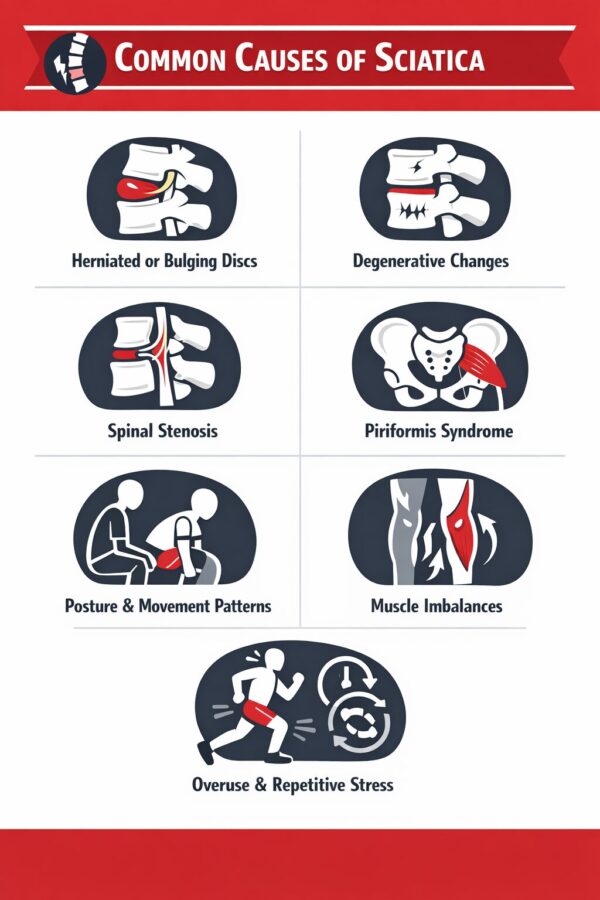
Sciatic nerve pain is often caused by the following conditions:
- Herniated or Bulging Discs: If the inner portion of a spinal disc (nucleus pulposus) pushes outward through the disc’s tougher outer layer, nearby nerve roots may become compressed, leading to sciatic nerve irritation.
- Degenerative Changes: Over time, normal wear and tear in the spine can narrow the spaces around nerves, increasing the risk of irritation that leads to sciatic pain.
- Spinal Stenosis: Spinal stenosis occurs when the spinal canal narrows over time, leaving less space for nerve structures and increasing the chance of nerve irritation.
- Piriformis Syndrome: Piriformis syndrome occurs when tight hip muscles press against the sciatic nerve along its path through the pelvis, resulting in discomfort or pain.
- Posture and Movement Patterns: Everyday posture and movement habits, such as sitting for long periods or lifting incorrectly, can place ongoing strain on the lower back and irritate the sciatic nerve.
- Muscle Imbalances: When core or hip muscles lack strength, additional stress may be placed on the lower back and pelvis, affecting the sciatic nerve over time.
- Overuse or Repetitive Stress: Overuse from repetitive activity, sports, or physical labor can place continuous stress on the spine, raising the risk of disc-related issues and sciatic nerve pain.
Identifying the specific cause of sciatica is an important part of treatment, which is why individualized evaluation by a doctor or physical therapist in Antonia, MO plays a key role in developing an effective care plan.
How Sciatica Affects Daily Life and Activity
Living with sciatica often disrupts daily activities by restricting movement and making certain positions or tasks uncomfortable.
Individuals with sciatica commonly struggle with:
- Remaining seated for long stretches, especially during desk work or driving
- Rising from a seated position, as a result of nerve irritation or muscle weakness
- Standing or walking for extended periods, that may aggravate pain in the leg
- Movements involving bending, lifting, or twisting, particularly during daily tasks
- Maintaining a comfortable sleeping position, due to pain radiating into the hip or leg
- Fitness routines or recreational exercise, especially during workouts or recreational exercise
Without proper treatment, these limitations can lead to other concerns, including:
- Reduced activity levels
- Increased stiffness and muscle deconditioning
- Decreased hip or core strength
- Increased fear of movement or reinjury
Sciatica treatment through Antonia, MO physical therapy focuses on restoring these functional abilities by:
- Improving tolerance for sitting, standing, and walking
- Relieving nerve irritation through structured movement
- Improving strength in the muscles that stabilize the spine and pelvis
- Helping patients learn safer ways to move during everyday activities
- Safely reintroducing physical activity over time
By addressing how sciatica affects real-world movement—not just pain—treatment helps patients return to work, daily routines, and the activities they love with greater comfort and control.
How Axes Physical Therapy in Antonia, MO Supports Sciatica Recovery
Sciatica care at Axes Physical Therapy in Antonia, MO centers on reducing nerve irritation and improving strength, mobility, and functional movement.
Axes Physical Therapy is not focused on quick fixes or short-term symptom relief. Our Antonia, MO physical therapists take a holistic approach to care, and when appropriate, coordinating with your doctor to understand how the spine, hips, and nervous system interact, and designing a customized treatment plan to match your body, daily demands, and recovery goals.
Physical therapy for sciatica may help by:
- Reducing pressure on the sciatic nerve
- Improving movement and mobility in the spine and hips
- Reinforcing muscles that help support the lower back
- Helping patients learn movement strategies to reduce recurring symptoms
By focusing on the underlying cause rather than just the pain itself, physical therapy helps many people in Antonia, MO avoid unnecessary medications, injections, or surgical interventions while supporting a safe return to daily activities.
Can Sciatica Go Away or Is Ongoing Treatment Needed?
In many cases, sciatica improves substantially and may fully resolve once the source of nerve irritation is identified and treated.
For many people, sciatica is a temporary condition. When symptoms are caused by issues such as a disc bulge, muscle tightness, or movement-related stress, reducing pressure on the sciatic nerve and restoring normal movement can lead to lasting relief.
When sciatica is related to ongoing or degenerative spinal conditions, symptoms may fluctuate over time rather than resolve completely. In these cases, care is aimed at managing symptoms, improving movement and strength, and lowering the chance of future flare-ups.
At-Home Ways to Manage Sciatica Symptoms Before Treatment Begins
Early sciatica symptoms can sometimes be managed at home using simple strategies while awaiting formal treatment. At-home management focuses on reducing nerve stress and maintaining light, controlled movement.
Common ways to manage sciatica symptoms at home include:
- Maintaining gentle activity: Light movement such as short walks can help prevent stiffness and reduce prolonged pressure on the sciatic nerve.
- Limiting prolonged sitting: Frequent position changes and supportive seating can help reduce symptom flare-ups.
- Heat and ice application: Applying heat may help loosen tight muscles, while ice can help reduce inflammation during flare-ups.
- Finding supportive positions: Adjusting sleep or resting positions may help decrease pressure on the sciatic nerve.
- Temporarily modifying activities: Temporarily avoiding movements that worsen pain, such as heavy lifting or repeated bending, can help prevent symptom escalation.
While these strategies may provide temporary relief, they do not address the underlying cause of sciatica. If sciatica symptoms do not improve or begin to interfere with daily activities, a professional evaluation can help determine next steps.
How Axes Physical Therapy Treats Sciatica in Antonia, MO
At Axes Physical Therapy in Antonia, MO, sciatica treatment plans are built using evidence-based, individualized strategies designed for pain relief and lasting recovery.
Comprehensive Evaluation
Each sciatica care plan begins with a detailed evaluation focused on overall movement and function. This assessment includes posture, joint mobility, muscle strength, nerve tension, and movement patterns to determine what may be contributing to symptoms.
By personalizing care based on your evaluation findings, treatment can be tailored to your specific symptoms rather than using a standard protocol.
Therapeutic Exercise Program
Exercise therapy for sciatica focuses on improving strength, stability, and flexibility while limiting strain on the sciatic nerve. Programs frequently emphasize the core, hips, and lower extremities to improve spinal support.
As strength and mobility improve, exercise therapy supports better movement patterns and reduced symptom flare-ups.
Manual Therapy & Hands-On Treatment
Manual therapy techniques, including soft tissue mobilization and joint mobilization, are sometimes used to support mobility, reduce muscle tension, and improve circulation. Such techniques are used to relieve discomfort and improve overall movement quality.
Manual therapy is always applied based on individual tolerance and clinical findings.
Education & Posture Coaching
Learning how daily movements affect symptoms can play an important role in preventing future flare-ups. Your Antonia, MO physical therapist provides guidance on posture, lifting mechanics, sitting strategies, and activity modification to reduce strain on the sciatic nerve.
Supportive Treatment Modalities
Supportive modalities, including heat, ice, electrical stimulation (TENS), or dry needling, may be incorporated when appropriate to assist with pain relief and tissue recovery. These tools are used selectively as part of a broader treatment plan, not as standalone solutions.
Post-Surgical & Pre-Surgical Rehabilitation
If surgery is needed to relieve pain, Axes offers both pre-surgical rehab and post-surgical rehab to support safe and effective recovery.
When to Consider Professional Care for Sciatica in Antonia, MO
Knowing when to seek treatment for sciatica can help prevent symptoms from becoming more persistent or disruptive. It may be time to seek evaluation if you notice:
- Persistent sciatic pain lasting weeks
- Symptoms that increase with sitting, standing, or movement
- Changes in sensation such as numbness, tingling, or weakness in the leg or foot
- Pain that does not improve with rest or over-the-counter measures
Prompt evaluation can lead to more efficient treatment and help promote a smoother recovery experience.
Why Choose Axes Physical Therapy for Sciatica Care in St. Louis
The provider you choose for sciatica treatment can influence both your experience and your results. Axes Physical Therapy proudly serves communities throughout St. Louis with a locally focused approach that includes:
- Experienced, licensed physical therapists
- One-on-one, patient-centered care
- Evidence-based treatment strategies
- In many cases, direct access to physical therapy
- Accessible clinic locations and flexible appointment options
Our team is committed to creating a supportive atmosphere that helps you feel confident and informed at every stage of recovery.
Call Axes Physical Therapy for Your Sciatica Treatment in St. Louis
Taking the first step toward sciatica relief should feel easy and manageable. If sciatic nerve pain is interfering with your daily life, Axes is here to help you get back to the activities you love and cherish most. You can:
- Reach out to the Axes Physical Therapy location nearest you
- Request an appointment online at a time that works for you
- Come to any Axes location for a free injury screening
Our therapists are committed to helping you feel confident in your movement and return comfortably to the activities that matter most.
Frequently Asked Questions About Sciatica Treatment
Is physical therapy effective for sciatica?
Yes. When sciatica symptoms are related to movement or muscle issues, physical therapy is often a recommended treatment option.
How long does sciatica treatment take?
Treatment duration varies depending on factors such as symptom severity and the cause of sciatica. While many people improve within several weeks, others may need additional time to fully recover.
Can I begin physical therapy without a referral?
Direct access allows many patients to begin physical therapy without a physician referral. Direct access allows you to start treatment sooner when appropriate.
When is severe sciatica pain a concern?
In cases of intense or worsening pain with additional neurological symptoms, medical evaluation is recommended. After serious conditions are ruled out, physical therapy is often included as part of a coordinated care plan.