Carpal Tunnel Syndrome: Symptoms, Causes, and Treatment Options in Concord, MO
When the median nerve is squeezed within the carpal tunnel, symptoms of carpal tunnel syndrome can begin. Early symptoms are frequently mild and irritating before becoming more limiting if the pressure continues.
If you’re in Concord, MO and you want a conservative, practical plan that helps you keep working and living normally and gets you back to the activities you love, hand therapy can be a practical place to begin. Treatment provided by licensed physical therapists serving Concord, MO with Axes Physical Therapy allows many people to address symptoms without putting life on hold.
You can reach out to your nearest Axes clinic, schedule an appointment online, or even visit one of our locations for a no-cost injury screening.
Quick Summary
- This condition involves compression of the median nerve in the wrist, which can result in changes in sensation, pain, and hand weakness.
- Symptoms often worsen at night and usually affect the thumb through part of the ring finger, while the little finger is typically spared.
- Multiple factors—including how the hand is used, wrist posture, inflammation, and overall health—can contribute to increased nerve pressure.
- Diagnosis is based on symptoms, physical exam findings, and sometimes nerve testing to confirm nerve compression.
- Non-surgical treatment is frequently successful, particularly when symptoms are addressed early with splinting, activity changes, and therapy.
- Ongoing nerve compression without intervention can result in progressive symptoms and long-term functional limitations.
Understanding Carpal Tunnel Syndrome
At the wrist, the carpal tunnel forms a tight space that structures must pass through. Its floor and sides are made up of small wrist bones, while a strong band of tissue—the transverse carpal ligament—forms the roof. Passing through this space is the median nerve, which originates in the neck and travels down the arm into the hand.
Increases in pressure inside the carpal tunnel, whether from swelling or other changes, can place stress on the median nerve. These changes can show up as numbness, tingling, or weakness that affects grip, pinch strength, and fine motor control.
Recognizing Symptoms of Carpal Tunnel Syndrome
Carpal tunnel syndrome doesn’t always begin with intense or sudden pain. Many people first notice a pattern of symptoms.
Typical carpal tunnel syndrome symptoms include:
- Altered sensation such as numbness or tingling in the thumb through part of the ring finger
- Aching, burning, or electric-type pain in the hand or wrist
- Nighttime symptoms, such as pain or tingling that wakes you from sleep
- A need to shake the hand out to “wake it up” or relieve numbness
- Weakness or clumsiness in the hand, particularly during gripping or detailed tasks
- Increased tendency to drop items
- Pain that feels like it’s coming from deep within the wrist or hand and may sometimes travel up the forearm
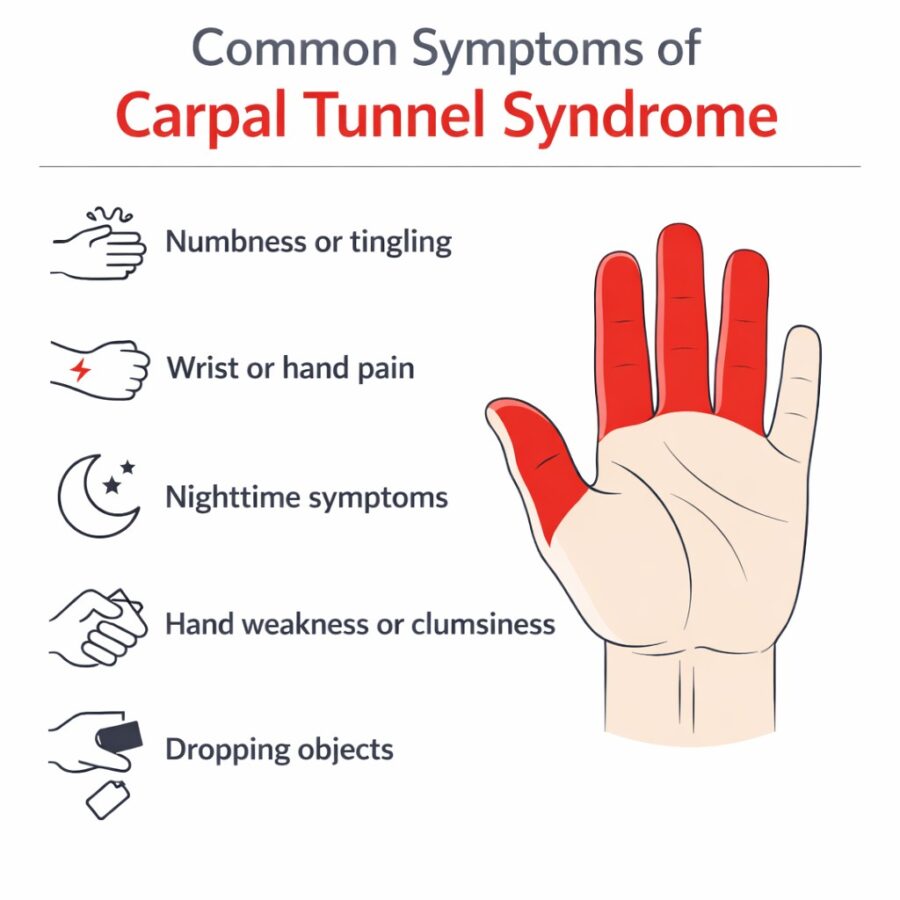
Common symptom patterns
Along with reported symptoms, providers frequently assess patterns that are characteristic of carpal tunnel syndrome:
- Symptoms that worsen at night or are noticeable first thing in the morning
- Symptoms triggered by sustained gripping or static wrist positions, including activities like reading or driving
- Symptoms that briefly improve when activity stops or the wrist position changes
A useful finger distribution clue
Paying attention to which fingers are involved can provide helpful diagnostic clues. Because the median nerve does not provide sensation to the little finger, carpal tunnel symptoms typically do not affect the pinky. If numbness or tingling consistently involves the little finger, it may point toward a different nerve or another cause of hand symptoms.
What Contributes to Carpal Tunnel Syndrome?
In many cases, carpal tunnel syndrome develops due to several contributing factors. Symptoms usually develop as pressure accumulates within the tight carpal tunnel space.
Common contributors include:
Ongoing wrist and hand demands
Typing, gripping, assembly work, tool use, and anything that keeps your wrist in awkward positions for long stretches can aggravate symptoms—especially if breaks are limited.
Inflammation-related pressure
Increased wrist swelling from injury or overuse can narrow the carpal tunnel and place added pressure on the median nerve. This limited space means that even minor inflammation can worsen symptoms, particularly early in the condition.
Structural and anatomical factors
Over time, arthritis or wrist injuries may alter the tunnel’s structure and increase nerve pressure.
Medical and lifestyle risk factors
Certain medical conditions are associated with higher CTS risk (for example: rheumatoid arthritis, diabetes, hypothyroidism, obesity).
Symptoms commonly appear during pregnancy and often improve after delivery, though some individuals may remain at higher risk later on.
Lifestyle factors such as smoking, heavy alcohol use, and poor nutrition may also play a role.

How Concord, MO Physical Therapists Diagnose Carpal Tunnel Syndrome
A diagnosis is often reached through a detailed symptom discussion and physical exam, with further testing considered in certain cases.
Why symptom patterns matter
Diagnosis often begins by reviewing the symptom patterns described above, particularly nighttime symptoms and numbness that occurs with sustained wrist positions or prolonged gripping.
Physical exam tests used to diagnose carpal tunnel syndrome
During the physical exam, our Concord, MO physical therapists may use simple in-office tests to see whether certain positions or light pressure reproduce symptoms associated with median nerve irritation, including:
- Phalen’s test – placing the wrist into flexion to assess whether tingling or numbness appears in the fingers
- Tinel’s sign – tapping along the median nerve at the wrist to assess for tingling or shock-like sensations
- Grip and strength testing – assessing grip strength and thumb muscles supplied by the median nerve
- Sensory testing – assessing sensation changes in the fingers typically involved in carpal tunnel syndrome
Symptom patterns and exam findings are interpreted together to determine if median nerve compression is present.
Situations that call for imaging or nerve testing
When symptoms are unclear or more advanced, therapists may suggest further testing, such as:
- X-rays – used to evaluate bone or joint conditions like arthritis or previous fractures, rather than to diagnose carpal tunnel syndrome directly
- Ultrasound – used to visualize the median nerve and surrounding structures and assess whether the nerve is being compressed at the wrist
- Nerve conduction studies and electromyography (EMG) – used to evaluate how well the median nerve and affected muscles are functioning and to help distinguish carpal tunnel syndrome from other nerve conditions
Electrodiagnostic testing is often considered the most definitive way to confirm median nerve compression when the diagnosis is unclear or symptoms are more advanced.
At-Home Care Options for Carpal Tunnel Syndrome in Concord, MO
In Concord, MO, treatment for carpal tunnel syndrome usually begins with conservative care. The goal is straightforward: reduce pressure/irritation on the median nerve, calm symptoms down, and change whatever is feeding the problem.
What you can do right away (mild symptoms)
If symptoms are mild, a short window of home care (1–2 weeks) may relieve symptoms, including:
- Temporarily reducing activities that aggravate symptoms
- Icing 10–15 minutes, 1-2 times an hour
- Considering NSAIDs for pain/swelling relief
- Using a wrist splint to limit pressure on the median nerve
In the early stages, activity breaks, ice, and avoiding irritating movements can reduce swelling and discomfort.
Physical Therapy for Carpal Tunnel Syndrome in Concord, MO
Basic strategies alone aren’t always enough—addressing why the nerve is irritated is key. That’s where Concord, MO physical therapy and hand therapy come in.
A comprehensive hand therapy program in Concord, MO may focus on:
- Calming irritation to the median nerve
- Improving wrist/forearm mobility and strength
- Improving upstream posture and movement that affect how the arm and wrist are loaded
- Supporting continued work and daily activities with reduced strain
What you might do in therapy
Physical therapy for carpal tunnel syndrome isn’t one-size-fits-all. Plans are modified over time depending on symptom response and functional needs. While no two plans are identical, your Concord, MO physical therapist may include some combination of the following components in your carpal tunnel treatment.
1) Symptom-calming strategies
Early treatment focuses on reducing irritation and giving the median nerve a chance to settle down. Early care prioritizes symptom relief over intensity.
Examples may include:
- Education on night splinting to maintain neutral wrist positioning
- Adjusting task duration or frequency to limit irritation
- Short-term adjustments to reduce strain during work, driving, or daily tasks
- Short-term taping support (including Kinesio Taping®) to help reduce irritation during activity when appropriate
The goal is to calm symptoms without requiring you to completely stop normal activities.
2) Mobility and tendon/nerve movement
Improving movement through the wrist and arm involves more than the nerve alone, which is why mobility work addresses the wrist, forearm, fingers, and nearby tissues. Limited motion or stiffness anywhere along the arm can increase strain at the wrist and contribute to symptoms.
Therapy may involve:
- Joint mobility techniques for the wrist and forearm to improve flexion, extension, and rotation
- Soft tissue techniques aimed at reducing forearm muscle stiffness, including manual therapy and instrument assisted soft tissue mobilization when appropriate
- Improving finger and thumb movement to address protective stiffness
- Tendon and nerve gliding exercises used on a case-by-case basis, such as:
- Tendon gliding: specific finger positions such as open hand, partial fist, and full fist to encourage smoother tendon movement through the carpal tunnel
- Median nerve gliding: carefully guided arm and wrist movements that help the median nerve move with less irritation
- When appropriate, trigger point dry needling may be included to reduce forearm muscle tension contributing to wrist strain
Better movement through the wrist and arm helps limit unnecessary stress during daily activities. Tendon and nerve gliding exercises are tools—not a standalone solution—and are introduced gradually as part of a broader treatment plan.
3) Strength, endurance, and functional training
Effective strengthening extends beyond simple hand squeezing. The emphasis is on restoring tolerance for real-world demands.
Training may involve:
- Gradual grip and pinch strengthening that progresses as symptoms improve
- Endurance-focused exercises to prepare for prolonged hand use, including typing or tool work
- Functional strengthening, including lifting, carrying, pushing, or pulling tasks that mimic work or daily demands
- Training the wrist and forearm to handle load in neutral and slightly altered positions
Treatment focuses on returning to normal activities while keeping symptoms controlled.
4) Ergonomics that actually work
Posture cues alone don’t solve the problem. Effective ergonomics looks at how small changes can reduce wrist and hand strain.
This may involve:
- Modifying keyboard, mouse, or tool setup to keep the wrist in a more neutral position
- Reducing grip force demands during work or daily tasks
- Changing task setup, height, or sequencing to limit prolonged wrist strain
Small adjustments can significantly reduce pressure on the median nerve over the course of a day. In work-related situations, advanced work rehabilitation and functional capacity evaluations may help support a safe return to job duties.
5) Therapeutic ultrasound when indicated
In some cases, therapeutic ultrasound may be used as part of treatment. Ultrasound parameters are adjusted to match individual needs. It is not a standalone treatment and is used alongside other interventions.
6) Pre- and post-surgical rehabilitation (when needed)
Pre- and post-operative rehabilitation can play an important role in restoring hand and wrist function when surgical care is part of treatment.
Common Questions About Carpal Tunnel Syndrome Treatment in Concord, MO
Does typing always lead to carpal tunnel syndrome?
No. Repetitive hand use like typing can play a role, but carpal tunnel syndrome is usually multifactorial, involving anatomy, inflammation, wrist posture, and certain health conditions.
Why do carpal tunnel symptoms flare up at night?
Nighttime symptoms are common because the wrist often bends during sleep and fluid shifts can increase pressure inside the carpal tunnel. Using a wrist splint while sleeping can limit wrist bending and reduce overnight symptoms.
How is carpal tunnel syndrome distinguished from other conditions?
Providers rely on symptom history, physical exam findings, and sometimes nerve testing to confirm carpal tunnel syndrome or exclude other conditions.
Can physical therapy really help carpal tunnel syndrome?
Yes. Physical and hand therapy are commonly used as part of conservative care and may include mobility work, strengthening, ergonomic adjustments, and activity modifications, often alongside splinting and other symptom-management strategies.
When might steroid injections be used?
Injections may be considered if conservative treatment hasn’t provided enough relief and temporary reduction in inflammation is needed.
At what point is surgery an option?
When non-surgical options fail or nerve damage is a concern, surgery may be discussed.
Physical Therapy for Carpal Tunnel Syndrome in Concord, MO
Axes Physical Therapy provides patient-focused care in Concord, MO through licensed physical and occupational therapists. Clinics offer advanced hand therapy services supported by experienced therapists and Certified Hand Therapists (CHTs) for conditions involving the hand and wrist.
If symptoms are starting to interfere with sleep, work, or everyday activities you don’t usually think twice about—like opening jars, gripping the steering wheel, texting, or lifting—it’s a good time to get a plan.
Schedule a physical therapy evaluation with Axes in Concord, MO to better understand your symptoms and create a treatment plan tailored to your needs. You can call the Axes location nearest you, request an appointment online, or come to any of our locations for a free injury screening to get started.