Carpal Tunnel Syndrome: Symptoms, Causes, and Treatment Options in Farmington, MO
Carpal tunnel syndrome develops as the median nerve becomes irritated within the tight passageway at the wrist. As nerve irritation increases, everyday hand and wrist use can become increasingly uncomfortable.
For people in Farmington, MO who want to stay active and productive without jumping straight to invasive care, focused hand therapy is often an effective first step. Working with local physical therapists in Farmington, MO with Axes Physical Therapy often focuses on getting people back to normal routines safely and confidently.
You can reach out to your nearest Axes clinic, schedule an appointment online, or even stop by any of our locations to take advantage of a complimentary injury screening.
Quick Summary
- Pressure on the median nerve within the wrist is what drives carpal tunnel syndrome and its common symptoms, including numbness, tingling, and weakness.
- Carpal tunnel symptoms frequently follow a specific finger pattern, affecting the thumb through ring finger while leaving the little finger unaffected, and may intensify overnight.
- Repetitive hand use, wrist position, swelling, and certain health conditions can all increase pressure on the nerve and contribute to symptoms.
- A combination of symptom history, clinical examination, and, in some cases, nerve studies is used to confirm carpal tunnel syndrome.
- Early conservative care often helps relieve symptoms and may involve splinting, activity modification, and therapeutic intervention.
- Delaying treatment may allow symptoms to advance and increase the risk of permanent nerve changes and hand weakness.
What Is Carpal Tunnel Syndrome?
At the wrist, the carpal tunnel forms a tight space that structures must pass through. The structure is bordered by wrist bones on the bottom and sides, with the transverse carpal ligament spanning across the top. Passing through this space is the median nerve, which originates in the neck and travels down the arm into the hand.
When pressure builds inside that space—because of swelling, irritation, or structural changes—the median nerve can get squeezed. As a result, people may experience altered sensation and reduced strength during everyday hand tasks.
Common Symptoms of Carpal Tunnel Syndrome
Carpal tunnel syndrome doesn’t always announce itself with a big dramatic pain spike. For many, symptoms follow recognizable patterns early on.
Common symptoms of carpal tunnel syndrome include:
- Numbness or tingling in the thumb, index finger, middle finger, and often part of the ring finger
- Uncomfortable sensations such as burning or electric-like pain in the wrist or hand
- Pain or tingling that occurs at night and disrupts sleep
- A need to shake the hand out to “wake it up” or relieve numbness
- Weakness or clumsiness in the hand, particularly during gripping or detailed tasks
- Objects slipping from the hand more often
- Deep wrist or hand pain that can occasionally extend into the forearm
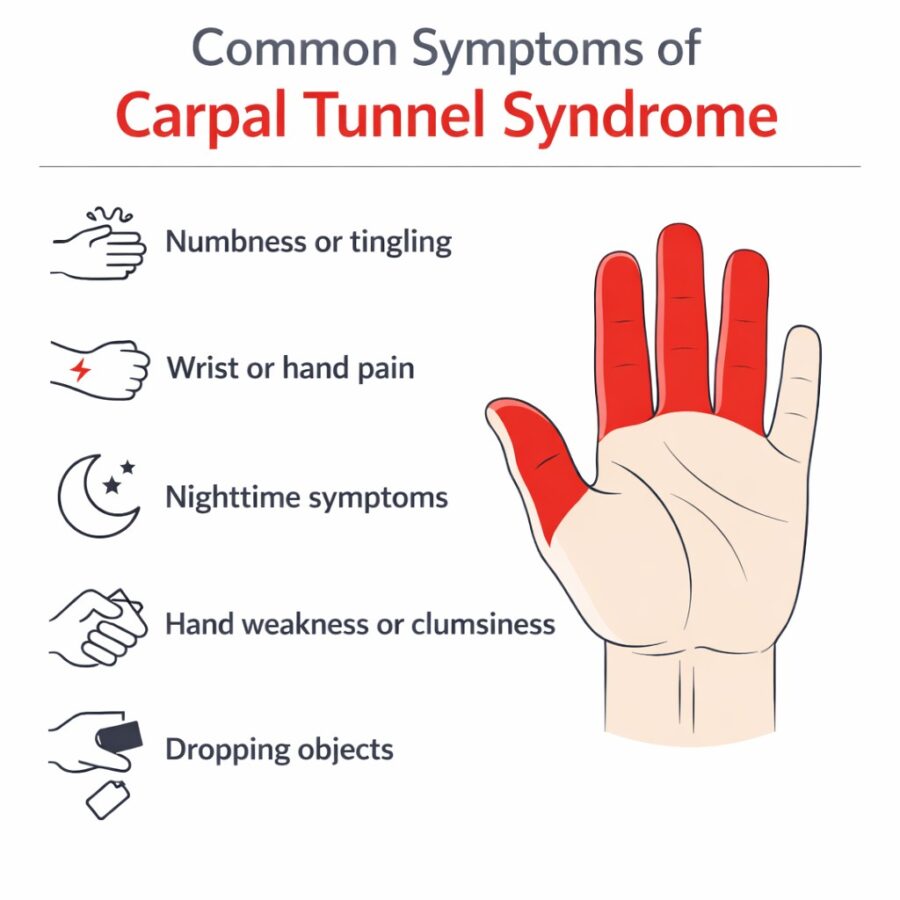
Common symptom patterns
Symptoms alone don’t tell the whole story, so clinicians also look for patterns that help identify carpal tunnel syndrome:
- Symptoms that are worse overnight or apparent early in the morning
- Numbness or tingling during sustained gripping or static wrist positions, such as holding a phone, reading a newspaper, or gripping a steering wheel
- Temporary symptom relief with rest, repositioning the wrist, or shaking the hand out
An important finger pattern clue
One key detail involves which fingers are experiencing symptoms. Because the median nerve does not provide sensation to the little finger, carpal tunnel symptoms typically do not affect the pinky. When the pinky is involved, it can indicate that something other than carpal tunnel syndrome is contributing to symptoms.
What Contributes to Carpal Tunnel Syndrome?
In many cases, carpal tunnel syndrome develops due to several contributing factors. Symptoms usually develop as pressure accumulates within the tight carpal tunnel space.
Contributing factors may include:
Ongoing wrist and hand demands
Jobs or activities that require repeated hand use or prolonged wrist positioning may worsen symptoms over time.
Wrist swelling and inflammation
Increased wrist swelling from injury or overuse can narrow the carpal tunnel and place added pressure on the median nerve. Even small increases in inflammation can raise pressure in this tight space, which is why rest, icing, and wrist splinting are often effective early strategies when symptoms are mild.
Anatomical contributors
Over time, arthritis or wrist injuries may alter the tunnel’s structure and increase nerve pressure.
Medical and lifestyle risk factors
Some health conditions are linked to increased carpal tunnel risk, including rheumatoid arthritis, diabetes, hypothyroidism, and obesity.
Pregnancy is also a common time for symptoms to show up, with symptoms often improving after delivery, though that group can be at higher risk later.
Unhealthy lifestyle factors may further contribute to carpal tunnel symptoms.

Diagnosing Carpal Tunnel Syndrome with Farmington, MO Physical Therapists
Diagnosis is usually a combination of your symptom story and a physical exam, sometimes with additional testing.
The symptom pattern matters (a lot)
Diagnosis often begins by reviewing the symptom patterns described above, particularly nighttime symptoms and numbness that occurs with sustained wrist positions or prolonged gripping.
Common in-office tests used during diagnosis
During the physical exam, our Farmington, MO physical therapists may use simple in-office tests to see whether certain positions or light pressure reproduce symptoms associated with median nerve irritation, including:
- Phalen’s test – placing the wrist into flexion to assess whether tingling or numbness appears in the fingers
- Tinel’s sign – lightly tapping over the median nerve to see if tingling or electrical sensations travel into the hand
- Grip and strength testing – assessing grip strength and thumb muscles supplied by the median nerve
- Sensation testing – evaluating sensory differences in the hand and fingers associated with median nerve compression
Physical exam findings are reviewed together with symptom history to assess for median nerve compression.
When additional testing may be needed
Depending on your case, your Farmington, MO physical therapist may also recommend or request:
- X-rays – helpful for identifying structural issues but not for confirming carpal tunnel syndrome itself
- Ultrasound – allows visualization of nerve size and surrounding structures at the wrist
- Nerve conduction studies and electromyography (EMG) – used to evaluate how well the median nerve and affected muscles are functioning and to help distinguish carpal tunnel syndrome from other nerve conditions
In situations where symptoms are unclear, electrodiagnostic testing can provide definitive confirmation of nerve compression.
At-Home Treatment Options for Carpal Tunnel Syndrome in Farmington, MO
Carpal tunnel care in Farmington, MO often starts with non-invasive approaches. The focus is simple—decrease irritation to the median nerve, settle symptoms, and address contributing factors.
What you can do right away (mild symptoms)
For mild symptoms, a short period of at-home care—often one to two weeks—may help relieve discomfort, including:
- Temporarily reducing activities that aggravate symptoms
- Icing 10–15 minutes, 1-2 times an hour
- Short-term use of NSAIDs for symptom relief
- Wearing a wrist splint to reduce pressure on the median nerve
Early on, simple steps like taking more frequent breaks, avoiding symptom-provoking activities, and using cold packs can help manage irritation and swelling.
How Farmington, MO Physical Therapy Treats Carpal Tunnel Syndrome
While splints and activity advice can be useful, most cases require a more comprehensive plan. That’s when working with a physical or hand therapist can make a difference.
An effective physical or hand therapy program in Farmington, MO typically emphasizes:
- Reducing nerve irritation
- Restoring wrist and forearm movement and strength
- Addressing posture and movement patterns higher up the chain, including the shoulder and neck
- Helping you keep doing your job and daily tasks with less strain
What treatment may look like
Treatment is tailored to each person’s symptoms and demands. Care is adapted based on how symptoms change and how the wrist tolerates activity. While no two plans are identical, your Farmington, MO physical therapist may include some combination of the following components in your carpal tunnel treatment.
1) Calming irritation and symptoms
Initial sessions aim to calm symptoms and reduce stress on the median nerve. This stage is not about forcing progress or pushing through discomfort.
This may involve:
- Guidance on night splinting to keep the wrist in a neutral position
- Activity modifications, such as changing how long or how often certain tasks are performed
- Temporary changes to reduce strain during daily activities
- Taping support, including Kinesio Taping®, when needed to reduce irritation
Care is designed to reduce symptoms without stopping normal routines.
2) Mobility and tendon/nerve movement
Mobility work focuses on how well the wrist, forearm, fingers, and surrounding tissues move—not just the nerve itself. When motion is limited along the arm, added strain may show up at the wrist and worsen symptoms.
Treatment may include:
- Improving wrist and forearm joint motion to restore bending, straightening, and rotational movement
- Soft tissue work to reduce stiffness in the forearm muscles and surrounding structures (including manual therapy and instrument assisted soft tissue mobilization when appropriate)
- Mobility work for the fingers and thumb to reduce stiffness or guarding
- Targeted tendon or nerve gliding exercises, used selectively when stiffness or sensitivity is present, such as:
- Tendon gliding: structured finger movement patterns designed to improve how flexor tendons move within the carpal tunnel
- Median nerve gliding: gentle arm, wrist, and finger movements that change nerve position to reduce sensitivity and improve mobility
- For some individuals, dry needling may be used to address muscle tension that increases stress on the wrist and hand
Improving mobility throughout the arm can reduce excess strain at the wrist and support more efficient movement. Tendon and nerve gliding exercises are tools—not a standalone solution—and are introduced gradually as part of a broader treatment plan.
3) Strength, endurance, and “real-life” training
Building strength is not limited to basic hand exercises. The emphasis is on restoring tolerance for real-world demands.
This may include:
- Progressive grip and pinch strengthening, starting light and increasing as symptoms allow
- Endurance-focused exercises to prepare for prolonged hand use, including typing or tool work
- Strength exercises that replicate work and daily activities such as lifting, carrying, pushing, or pulling
- Exercises that build tolerance to load across different wrist positions
Treatment focuses on returning to normal activities while keeping symptoms controlled.
4) Ergonomics that actually work
“Sit up straight” isn’t a plan. Ergonomics focuses on practical adjustments that limit strain on the wrist and hand.
Ergonomic changes may include:
- Adjusting keyboard, mouse, or tool positioning so the wrist stays closer to neutral
- Lowering grip force requirements during job tasks or daily activities
- Adjusting task height, setup, or order to reduce sustained wrist strain
Small adjustments can significantly reduce pressure on the median nerve over the course of a day. When symptoms are work-related, work rehabilitation programs and functional capacity evaluations may assist with return-to-work planning.
5) Therapeutic ultrasound (when appropriate)
Ultrasound is sometimes used as an adjunct to other treatment strategies. When used, ultrasound is applied with parameters tailored to the individual. It is not a standalone treatment and is used alongside other interventions.
6) Rehabilitation before and after surgery, when appropriate
Pre- and post-operative rehabilitation can play an important role in restoring hand and wrist function when surgical care is part of treatment.
Common Questions About Carpal Tunnel Syndrome Treatment in Farmington, MO
Is carpal tunnel syndrome always caused by typing?
Not always. While repetitive wrist and hand use can contribute, carpal tunnel syndrome is often influenced by multiple factors, including anatomy, swelling or inflammation, wrist positioning, and underlying health conditions.
Why is carpal tunnel syndrome worse at night?
Symptoms frequently worsen at night due to wrist positioning during sleep and normal fluid shifts that raise pressure in the carpal tunnel. Night splinting helps maintain a neutral wrist position and may relieve nighttime symptoms.
How can providers tell if symptoms are carpal tunnel syndrome?
When symptoms are unclear, additional testing may be used alongside exam findings to confirm median nerve compression.
Is physical therapy effective for carpal tunnel syndrome?
Yes. Conservative care often includes physical or hand therapy, which may address mobility, strength, ergonomics, and activity demands in combination with splinting.
When do injections make sense?
Corticosteroid injections may be considered when symptoms don’t improve with other conservative care and short-term pain relief is needed to reduce inflammation and nerve irritation.
When should surgery be considered for carpal tunnel syndrome?
Surgery is typically considered when conservative treatment doesn’t provide relief, symptoms are severe or long-standing, or there is concern about ongoing nerve damage.
Physical Therapy Care for Carpal Tunnel Syndrome in Farmington, MO
Axes Physical Therapy serves patients in Farmington, MO with individualized care provided by licensed physical and occupational therapists. Clinics offer advanced hand therapy services supported by experienced therapists and Certified Hand Therapists (CHTs) for conditions involving the hand and wrist.
When everyday tasks start to feel harder because of wrist or hand symptoms, early evaluation can help guide next steps.
Schedule a physical therapy evaluation with Axes in Farmington, MO to confirm what’s going on and map out a treatment path that fits your life. Get started by calling the nearest Axes location, scheduling online, or visiting any clinic for a free injury screening.