
Frozen Shoulder Physical Therapy in Jefferson City, MO. Frozen shoulder can turn ordinary shoulder movement into a daily negotiation. You may notice trouble reaching into a cabinet, pulling on clothing, lifting at work, exercising, golfing, or completing repetitive tasks. As stiffness increases, even finding a comfortable sleeping position may become frustrating.
Frozen shoulder recovery can be slow, but surgery is not the usual starting point. Axes Physical Therapy in Jefferson City, MO develops treatment around the stage your shoulder is in now, with the goals of controlling pain, improving motion, rebuilding strength, and getting you back to the activities that have become difficult.
You may not need to wait for a physician referral before having a stiff, painful shoulder evaluated. Under Missouri’s direct access law, many patients in Jefferson City, MO can begin physical therapy directly. Axes can also typically schedule new patients within 24 to 48 hours of initial outreach.
To get started, you can request an appointment online, call the location nearest you, or come by for a free injury screening.
Some shoulder symptoms should be medically evaluated promptly rather than treated as routine stiffness. These include pain after an acute injury, severe swelling, visible deformity, major weakness, numbness or tingling, or difficulty moving the arm at all.
This page covers:
- What frozen shoulder is and why shoulder movement becomes restricted
- How frozen shoulder changes during the freezing, frozen, and thawing stages
- How physical therapy for frozen shoulder changes as symptoms change
- What to expect during recovery and how to handle daily activity between appointments
What Does Frozen Shoulder Mean?
Frozen shoulder, also called adhesive capsulitis, is a condition that makes the shoulder increasingly painful and stiff. The problem develops in the joint capsule, a flexible layer of tissue that surrounds the shoulder’s ball-and-socket joint. With frozen shoulder, this tissue becomes thicker and tighter, making it harder for the joint to move freely.
As that happens, the shoulder gradually loses range of motion. Reaching overhead, reaching behind your back, or rotating your arm outward can become especially difficult.
Frozen shoulder usually restricts movement in two different ways. You cannot move the shoulder normally on your own, and someone else may also be unable to move it through a normal range. This loss of both active and passive range of motion is one feature that can help a physical therapist distinguish adhesive capsulitis from other shoulder problems.
One of the clearest early changes can be loss of external rotation. With your elbow held near your side, turning the forearm outward may feel unusually restricted. As frozen shoulder progresses, reaching overhead and behind the back often becomes limited too.
How Frozen Shoulder Usually Feels
The condition commonly develops gradually. Pain may be the first obvious problem, with stiffness and loss of motion becoming more noticeable over the following weeks or months.
- A deep or aching pain in the shoulder
- A gradual decline in how far the shoulder can move
- Pain that is worse at night or interferes with sleep
- Trouble reaching shelves, cabinets, or other overhead areas
- Loss of motion when reaching toward the back pocket or fastening clothing
- Difficulty putting on shirts, jackets, bras, or other clothing
- Difficulty with grooming, driving, lifting, or household tasks
- Limited passive motion in addition to difficulty moving the arm yourself
The condition changes character as it progresses. Early recovery may revolve around pain control, while later visits may focus much more heavily on mobility. Using the same treatment intensity from the first stage through the last would ignore those differences.
A stiff shoulder changes more than the shoulder itself. When the joint cannot provide enough motion, the body may find other ways to complete the task, such as shrugging, leaning sideways, rotating the trunk, or relying more heavily on the other arm. Those compensations can show up during work, exercise, sports, and daily life.
How Does Frozen Shoulder Start?
Frozen shoulder can develop with or without an identifiable trigger. Some people have no preceding injury at all, while others first experience stiffness after healing from another shoulder problem or spending an extended period using the arm less than usual.
Frozen shoulder may develop:
- Without a clear cause: The shoulder may progressively lose motion even though nothing specific happened to start the problem.
- Following surgery or trauma: Pain and healing after surgery, fracture, or another shoulder injury can temporarily limit normal movement.
- Following prolonged reduced use: Shoulder stiffness can increase when the joint has not moved through its usual range for a prolonged period.
Who Commonly Develops Frozen Shoulder?
Anyone can develop shoulder stiffness, but frozen shoulder is especially associated with certain groups. The condition occurs most often during middle age and has stronger associations with health conditions including diabetes and thyroid disease.
How Does Frozen Shoulder Progress?
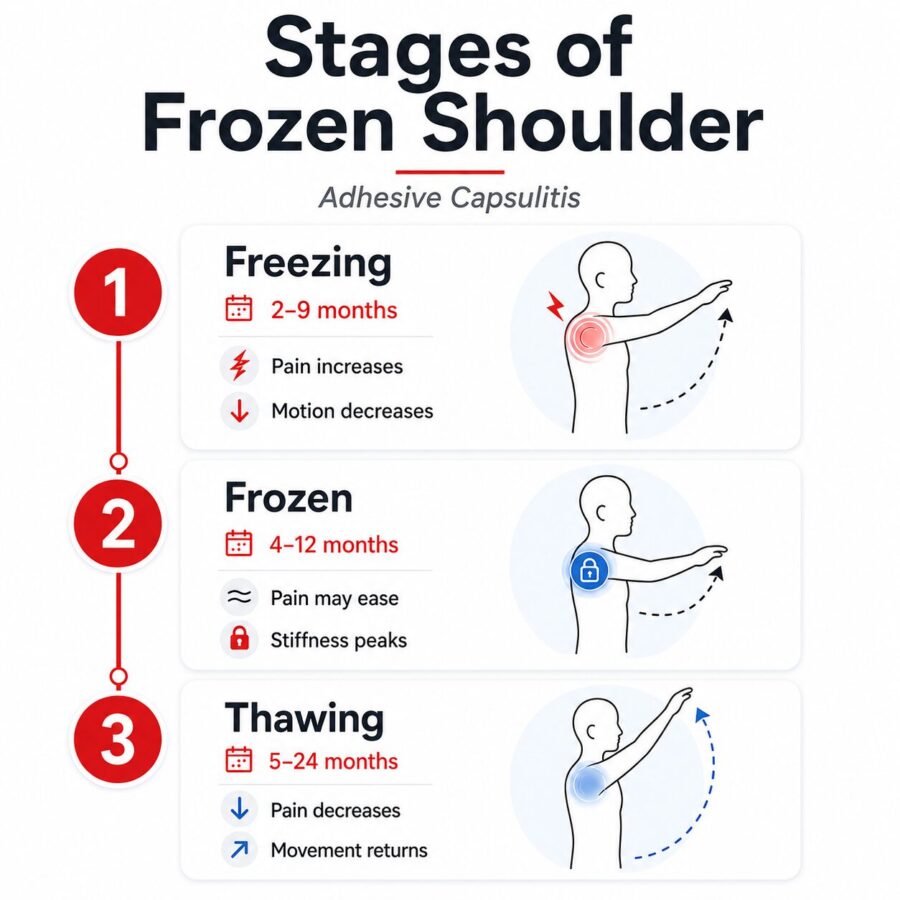
The course of frozen shoulder is usually divided into three broad stages. These phases do not follow an identical timeline for everyone, and the balance between pain and stiffness changes as the shoulder moves through them:
- The freezing phase: This is often the most painful phase. Range of motion begins shrinking, sleep may be disrupted, and quick or reaching movements can cause significant discomfort. 2 to 9 Months.
- The frozen phase: Pain may begin to ease, but stiffness is often at its worst. Reaching overhead, behind your back, or away from your body can remain difficult. Approximately 4 to 12 Months.
- Stage 3: Thawing: The direction finally begins to reverse. Range of motion slowly increases, stiffness eases, and tasks that had become difficult start becoming more manageable. Typical Duration: 5 to 24 Months.
Those time ranges describe common patterns, not a schedule every shoulder must follow. Some people progress faster. Physical therapy in Jefferson City, MO can be adjusted throughout the process so treatment continues addressing the limitations that are most relevant at each stage.
How Is Frozen Shoulder Diagnosed in Jefferson City, MO?
There is no single symptom that establishes frozen shoulder on its own. Evaluation typically combines your history, the way symptoms developed, and findings from a physical examination.
A Jefferson City, MO provider evaluating a stiff shoulder is looking for a pattern, not simply one painful motion. They may compare multiple directions of movement, assess strength and posture, and determine whether passive motion is restricted along with active motion.
A scan is not automatically required when the examination strongly suggests frozen shoulder. Imaging becomes more useful when another condition could explain the symptoms. Depending on the situation, X-rays, MRI, or ultrasound may help evaluate problems such as arthritis or a rotator cuff injury.
Physical Therapy for Frozen Shoulder in Jefferson City, MO
Frozen shoulder rehab is not about forcing the joint through the same routine at every visit. The challenge is to work within what the shoulder currently tolerates while steadily building toward better mobility and function.
Think of treatment priorities as a moving target. Pain may dominate the freezing stage, stiffness may take over in the frozen stage, and later recovery may reveal weakness or compensations that were less obvious before. Improving mobility is only one part of that progression.
Managing Pain While Keeping the Shoulder Moving
When pain and irritability are high, therapy may include:
- Comfortable movement within a tolerable range
- Hands-on techniques selected for your current symptoms
- Activity modifications
- Ways to preserve useful arm movement without causing repeated symptom flares
A large part of early frozen shoulder management happens between appointments. Your physical therapist can help you make practical changes to sleep, work, exercise, dressing, reaching, and other daily activities so you are not constantly provoking the shoulder.
Restoring Shoulder Mobility
Improving mobility does not necessarily mean forcing the shoulder as far as possible. Your physical therapist can progressively work on restricted directions using targeted exercises, stretching, and manual techniques. Progress may come a little at a time, but those small changes can have a large effect on daily function.
Rebuilding Shoulder Strength
A shoulder that moves farther also needs enough strength and control to use that new motion. As range improves, exercises may begin targeting the rotator cuff, shoulder blade muscles, upper back, and other supporting muscle groups. Resistance can then be increased as tolerance improves.
Correcting Compensatory Movement Patterns
Months of restricted shoulder movement can teach the body new ways to complete old tasks. You may hike the shoulder blade, lean the trunk, rotate through the spine, or depend more on the opposite arm. Physical therapy can help unwind those habits as shoulder motion returns.
Returning to Work, Exercise, Sports, and Daily Activities
Once basic motion and strength have improved, rehabilitation can become much more specific. Someone returning to golf needs different preparation than someone lifting equipment at work or resuming strength training. Your Jefferson City, MO therapist can progressively rebuild the exact movements and loads your goals require.
Why Choose Axes Physical Therapy for Frozen Shoulder Treatment in Jefferson City, MO?
You cannot rush every stage of frozen shoulder, but you can still be active about recovery. The right plan can help you protect an irritable shoulder, address stiffness when it becomes appropriate, and rebuild function as movement returns.
At Axes Physical Therapy in Jefferson City, MO, treatment is based on your current symptoms, stage of recovery, functional limitations, and the activities you want to regain.
Individualized care: Your program is adjusted as pain, mobility, strength, and function change.
Stage-appropriate care: Treatment intensity can progress with your shoulder instead of forcing the same exercises from beginning to end.
Prompt access to care: Axes can typically schedule new patients in Jefferson City, MO within 24 to 48 hours of initial outreach.
Direct Access support: Not sure whether you need a physician referral? Axes can help determine whether your situation qualifies for Direct Access physical therapy in Jefferson City, MO.
Help when physical therapy is not the only next step: Not every stiff shoulder should remain solely in physical therapy. When findings point toward another concern, your therapist can help connect the dots between rehabilitation and the medical care you may need next.
Complimentary injury screenings: You do not need to know exactly what is wrong before contacting Axes. A free injury screening can be a simple starting point if you are unsure whether your symptoms sound like frozen shoulder or something else.
Frozen Shoulder Treatment FAQs in Jefferson City, MO
Can physical therapy help frozen shoulder?
Physical therapy is commonly used as a primary treatment for frozen shoulder. Treatment can help manage pain, preserve or restore shoulder mobility, rebuild strength, and improve your ability to perform everyday activities. The specific approach should change based on how painful and restricted the shoulder is.
How can I recover from frozen shoulder faster?
Frozen shoulder does not have a dependable overnight fix. The condition usually improves gradually, and rehabilitation needs to respect that timeline. Pushing a painful shoulder aggressively in an attempt to speed things up can sometimes make symptoms worse rather than producing faster progress.
Should frozen shoulder be stretched aggressively?
Yes, stretching is commonly part of treatment. The important question is how hard, how often, and in which direction. Those decisions should reflect your current pain level and stage of recovery rather than a one-size-fits-all rule.
Will frozen shoulder eventually improve?
Frozen shoulder tends to improve over time, even without surgery, but the process can be lengthy. Physical therapy can help manage pain, improve motion and function, and guide activity throughout the different stages of recovery.
What should I not do with frozen shoulder?
There is no universal blacklist of exercises for every frozen shoulder. What matters is how your shoulder responds. A movement that is too provocative early in recovery may become useful later, which is why progression should be based on symptoms and function.
Can you get frozen shoulder twice?
It is relatively uncommon for the same shoulder to go through another full episode of frozen shoulder. However, some people later develop adhesive capsulitis on the opposite side, particularly when other risk factors are present.
Can frozen shoulder be treated without surgery?
Surgery is not the usual first-line treatment for frozen shoulder. Most people begin with conservative care, including physical therapy. Procedures such as manipulation under anesthesia or arthroscopic treatment are generally considered only when significant symptoms persist despite nonsurgical treatment.
When should I see a physical therapist in Jefferson City, MO for shoulder stiffness?
A shoulder that continues becoming stiffer deserves attention, particularly when the change begins affecting sleep, dressing, lifting, reaching, or personal care. An evaluation can help determine whether the pattern fits frozen shoulder or another condition.
Get Help for Frozen Shoulder in Jefferson City, MO
Frozen shoulder can take time to improve, but you do not have to wait it out on your own. Physical therapy in Jefferson City, MO can help reduce pain, improve mobility and strength, and help you return to work, exercise, sports, and everyday activities as your shoulder recovers.
The goal is not to force every frozen shoulder through the same template. Axes can continually adjust treatment according to where your shoulder is in the recovery process.
Request an appointment, contact your nearest Axes Physical Therapy location, or schedule a free injury screening to get started.