Frozen Shoulder Treatment Saint Paul, MO. Frozen shoulder does not only affect obvious athletic or overhead movements. As the shoulder loses mobility, getting dressed, reaching behind your body, lifting weights, doing manual work, handling household tasks, or sleeping on the affected side may all become harder.
Frozen shoulder recovery can be slow, but surgery is not the usual starting point. Axes Physical Therapy in Saint Paul, MO develops treatment around the stage your shoulder is in now, with the goals of controlling pain, improving motion, rebuilding strength, and getting you back to the activities that have become difficult.
Axes can often be an early point of care for people in Saint Paul, MO whose shoulder is becoming painful or harder to move. Missouri’s direct access law gives many patients the ability to start physical therapy without first seeing a physician, while Axes can typically schedule an initial visit within 24 to 48 hours of contact.
Not sure which next step makes sense? You can schedule a free injury screening, reach out to your nearest Axes clinic, or request a physical therapy appointment online.
Do not delay medical evaluation if the shoulder looks deformed, becomes severely swollen, cannot be moved, or develops significant weakness, numbness, or tingling, particularly after an acute injury.
Topics covered below include:
- What changes inside the shoulder when frozen shoulder develops
- How frozen shoulder changes during the freezing, frozen, and thawing stages
- How physical therapy for frozen shoulder changes as symptoms change
- What recovery can look like and how to manage your shoulder between visits
What Happens Inside a Frozen Shoulder?
The stiffness of frozen shoulder does not come only from weak or sore muscles. Much of the restriction occurs in the tissue surrounding the joint itself. That tissue, known as the joint capsule, normally has enough flexibility to allow broad shoulder movement. With adhesive capsulitis, the capsule thickens and tightens.
Because the joint can no longer move as freely, everyday reaching becomes harder. Overhead movement, reaching behind your back, and outward rotation of the arm are commonly restricted.
Suppose lifting your arm on your own is difficult. With some shoulder injuries, another person may still be able to move the joint through a larger range. Frozen shoulder is different because passive movement is often restricted too. Limitation of both active and passive motion is a characteristic finding.
External rotation, such as rotating your forearm away from your body with your elbow near your side, is often one of the first and most noticeable movements to become restricted. Reaching overhead and behind your back commonly become more difficult as the condition progresses.
Common Symptoms of Frozen Shoulder
The condition commonly develops gradually. Pain may be the first obvious problem, with stiffness and loss of motion becoming more noticeable over the following weeks or months.
- A persistent ache or deeper pain within the shoulder
- A gradual decline in how far the shoulder can move
- Night pain that makes comfortable sleep difficult
- Trouble reaching shelves, cabinets, or other overhead areas
- Loss of motion when reaching toward the back pocket or fastening clothing
- Shoulder restriction that makes dressing uncomfortable
- Reduced shoulder function during routine household and personal-care activities
- Limited passive motion in addition to difficulty moving the arm yourself
The condition changes character as it progresses. Early recovery may revolve around pain control, while later visits may focus much more heavily on mobility. Using the same treatment intensity from the first stage through the last would ignore those differences.
A stiff shoulder changes more than the shoulder itself. When the joint cannot provide enough motion, the body may find other ways to complete the task, such as shrugging, leaning sideways, rotating the trunk, or relying more heavily on the other arm. Those compensations can show up during work, exercise, sports, and daily life.
What Causes Frozen Shoulder?
Not everyone can point to a specific event that started frozen shoulder. In some cases, pain and stiffness seem to appear on their own. In others, the condition follows an injury, surgery, or another period when the arm has not been moving normally.
Frozen shoulder may develop:
- Without an obvious trigger: Some people develop increasing pain and stiffness despite no identifiable injury or event.
- After an injury or surgery: The arm may be used less during recovery from a fracture, operation, or other shoulder condition, giving stiffness an opportunity to develop.
- Following prolonged reduced use: An extended period of using the shoulder less than normal can contribute to progressive restriction.
Frozen Shoulder Risk Factors
Among people in Saint Paul, MO, a history of diabetes or thyroid problems may increase the likelihood of frozen shoulder. The condition is also most frequently diagnosed in middle-aged adults.
How Does Frozen Shoulder Progress?
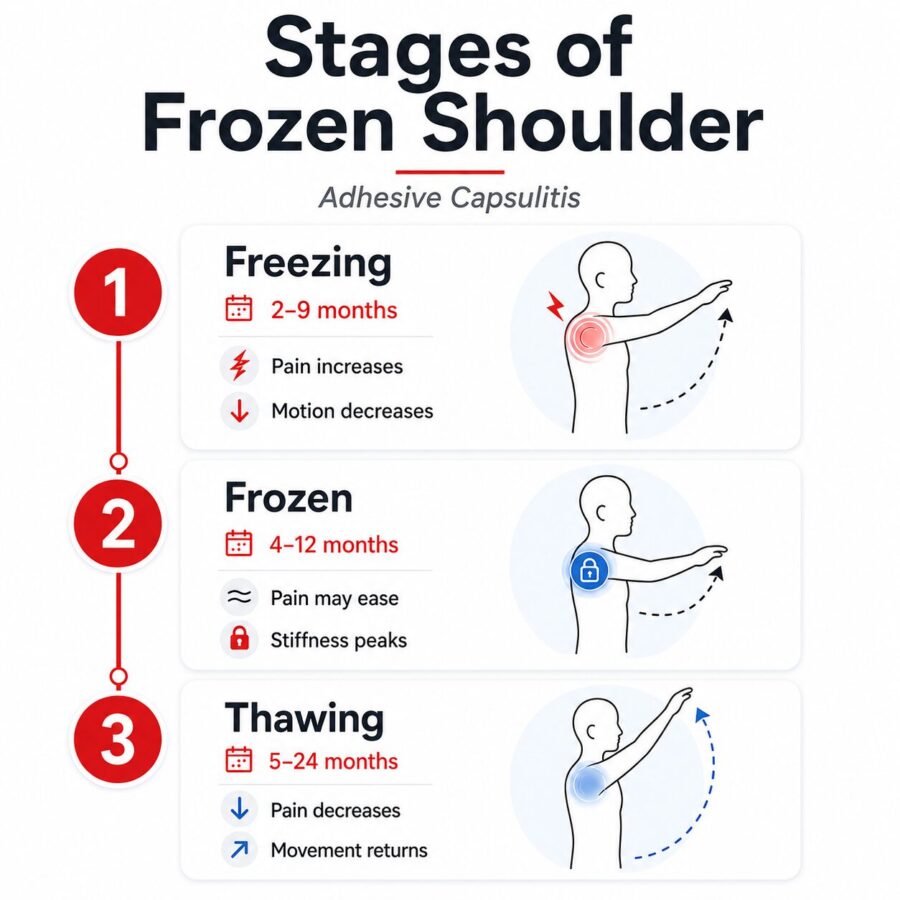
Frozen shoulder typically progresses through three stages. The timing varies, but each stage tends to have a different mix of pain and stiffness:
- Stage 1: Freezing: The shoulder progressively hurts more and moves less. Many people notice pain at night along with increasing difficulty reaching, dressing, or making sudden arm movements. Approximately 2 to 9 Months.
- Stage 2: Frozen: For some people, this stage feels less painful than the first but more mechanically restrictive. The shoulder may simply refuse to move far enough for many normal tasks. 4 to 12 Months.
- The thawing phase: Shoulder movement gradually improves, and everyday activities become easier as pain decreases and mobility returns. Typical Duration: 5 to 24 Months.
Those time ranges describe common patterns, not a schedule every shoulder must follow. Some people progress faster. Physical therapy in Saint Paul, MO can be adjusted throughout the process so treatment continues addressing the limitations that are most relevant at each stage.
Diagnosing Frozen Shoulder in Saint Paul, MO
A frozen shoulder diagnosis usually begins with your symptoms, medical history, and a physical examination.
A Saint Paul, MO provider evaluating a stiff shoulder is looking for a pattern, not simply one painful motion. They may compare multiple directions of movement, assess strength and posture, and determine whether passive motion is restricted along with active motion.
Imaging may play more of a supporting role than a diagnostic one. Your provider might recommend an X-ray, MRI, or ultrasound when they need to determine whether arthritis, a rotator cuff injury, or another problem is contributing to your loss of motion.
How Saint Paul, MO Physical Therapy Treats Frozen Shoulder
Frozen shoulder rehab is not about forcing the joint through the same routine at every visit. The challenge is to work within what the shoulder currently tolerates while steadily building toward better mobility and function.
The shoulder does not need the same thing at every stage. When pain is high, aggressive mobility work may not be appropriate. When pain settles, stiffness may demand more attention. Once mobility begins returning, strength and movement quality often become more important. Your Axes therapist in Saint Paul, MO can modify the plan accordingly.
Working With Pain During the Freezing Stage
Early treatment may focus on:
- Low-intensity shoulder mobility work
- Manual treatment from your physical therapist
- Activity modifications
- Ways to preserve useful arm movement without causing repeated symptom flares
A large part of early frozen shoulder management happens between appointments. Your physical therapist can help you make practical changes to sleep, work, exercise, dressing, reaching, and other daily activities so you are not constantly provoking the shoulder.
Helping the Shoulder Move More Freely
Improving mobility does not necessarily mean forcing the shoulder as far as possible. Your physical therapist can progressively work on restricted directions using targeted exercises, stretching, and manual techniques. Progress may come a little at a time, but those small changes can have a large effect on daily function.
Building a Stronger, More Capable Shoulder
As mobility returns, strengthening may focus on the rotator cuff, shoulder blade muscles, upper back, and other muscles that support normal arm movement. Resistance and exercise difficulty can increase gradually as your shoulder becomes more comfortable and capable.
Restoring Normal Upper-Body Movement
Months of restricted shoulder movement can teach the body new ways to complete old tasks. You may hike the shoulder blade, lean the trunk, rotate through the spine, or depend more on the opposite arm. Physical therapy can help unwind those habits as shoulder motion returns.
Getting Back to the Activities Frozen Shoulder Interrupted
Different activities ask different things of the shoulder. As recovery advances, your program can shift toward the reaching, lifting, rotation, endurance, and resistance involved in your job, sport, workouts, hobbies, and daily routine.
What Axes Offers Patients With Frozen Shoulder in Saint Paul, MO
You cannot rush every stage of frozen shoulder, but you can still be active about recovery. The right plan can help you protect an irritable shoulder, address stiffness when it becomes appropriate, and rebuild function as movement returns.
Axes Physical Therapy in Saint Paul, MO does not approach every frozen shoulder the same way. Your program can be built around the stage you are in, the movements you have lost, the amount of pain you are experiencing, and what you need the shoulder to do again.
Personalized treatment: Exercises, hands-on treatment, activity guidance, and progression can all be modified according to how your shoulder responds.
Progression based on symptoms: Treatment can become more challenging when the shoulder is ready instead of assuming that more aggressive care is always better.
Convenient new-patient scheduling: Axes generally offers initial appointments within 24 to 48 hours of outreach, helping you avoid a long delay before having the shoulder evaluated.
Guidance on whether you need a referral: Missouri law allows many patients to begin physical therapy directly, but individual circumstances can vary. Axes can help you understand what applies to you.
Help when physical therapy is not the only next step: Physical therapists also need to recognize when another provider should be involved. If your examination suggests imaging, orthopedic care, an injection consultation, or another medical service may be useful, Axes can help guide you forward.
Free injury screenings: Shoulder pain and stiffness can have several causes. A free injury screening can help you get initial guidance when you are unsure where to start.
Questions Patients Ask About Frozen Shoulder in Saint Paul, MO
Does physical therapy work for frozen shoulder?
Physical therapy is commonly used as a primary treatment for frozen shoulder. Treatment can help manage pain, preserve or restore shoulder mobility, rebuild strength, and improve your ability to perform everyday activities. The specific approach should change based on how painful and restricted the shoulder is.
What is the fastest way to treat frozen shoulder?
The fastest route is not necessarily the most aggressive route. Early treatment may be about controlling irritation and maintaining useful movement, while later treatment can work more directly on stiffness and strength. Trying to force motion before the shoulder can tolerate it may backfire.
Should frozen shoulder be stretched aggressively?
A frozen shoulder often needs mobility work, but timing matters. Early in the condition, pushing hard into painful motion can irritate the joint. Later, when the shoulder is less reactive, more deliberate stretching may be appropriate.
Does frozen shoulder resolve naturally?
Many frozen shoulders gradually improve without surgery, although the process may take a long time. Physical therapy does not simply wait for that recovery to happen. It can help you manage symptoms and work on mobility, strength, and function along the way.
Are there movements I should avoid with frozen shoulder?
Frozen shoulder exercises should challenge the shoulder appropriately, not punish it. Movements that create major or lingering pain may be more aggressive than the joint can currently tolerate. The right exercises can change as recovery progresses.
Can you get frozen shoulder twice?
A second episode in the identical shoulder is not common, but frozen shoulder can later appear in the other arm. Medical conditions associated with adhesive capsulitis may also influence future risk.
Will I need surgery for frozen shoulder?
Surgery is not the usual first-line treatment for frozen shoulder. Most people begin with conservative care, including physical therapy. Procedures such as manipulation under anesthesia or arthroscopic treatment are generally considered only when significant symptoms persist despite nonsurgical treatment.
When should I see a physical therapist in Saint Paul, MO for shoulder stiffness?
You do not have to wait until the shoulder is nearly immobile. If motion is steadily decreasing, sleep is becoming difficult, or everyday activities are getting harder, a Saint Paul, MO physical therapy evaluation may help identify what is happening. Several shoulder problems can look similar at first.
Start Moving Forward From Frozen Shoulder in Saint Paul, MO
Frozen shoulder can take time to improve, but you do not have to wait it out on your own. Physical therapy in Saint Paul, MO can help reduce pain, improve mobility and strength, and help you return to work, exercise, sports, and everyday activities as your shoulder recovers.
Your Axes program does not need to stay frozen just because your shoulder is. Treatment can keep evolving as pain, mobility, strength, and function change.
Request an appointment, contact your nearest Axes Physical Therapy location, or schedule a free injury screening to get started.