Frozen Shoulder Physical Therapy in Union, MO. Frozen shoulder often starts changing the way you use your arm long before you stop using it altogether. Everyday movements such as dressing, reaching, lifting, working with tools, exercising, or playing golf may become painful or restricted, and nighttime discomfort can make sleep difficult.
Most people with frozen shoulder do not ultimately need surgery. Physical therapy can instead change with the condition as pain, stiffness, mobility, and strength change. At Axes Physical Therapy in Union, MO, your plan is built around restoring the shoulder function you need for work, exercise, sports, hobbies, and everyday life.
When shoulder stiffness starts affecting normal life, getting an evaluation does not always require another appointment first. Many people in Union, MO qualify to begin physical therapy without a physician referral through Missouri Direct Access, and Axes typically offers scheduling within 24 to 48 hours after initial outreach.
There are several ways to begin. Request an appointment online, contact the Axes location nearest you, or start with a free injury screening.
Some shoulder symptoms should be medically evaluated promptly rather than treated as routine stiffness. These include pain after an acute injury, severe swelling, visible deformity, major weakness, numbness or tingling, or difficulty moving the arm at all.
Here is what we will cover:
- Why adhesive capsulitis causes the shoulder to become stiff and difficult to move
- The three general stages of frozen shoulder and how symptoms differ between them
- Why treatment may look different in early, middle, and later recovery
- What recovery can look like and how to manage your shoulder between visits
What Does Frozen Shoulder Mean?
Inside a healthy shoulder, the ball-and-socket joint is surrounded by a flexible sleeve of tissue called the joint capsule. Frozen shoulder, or adhesive capsulitis, develops when that capsule becomes thicker and tighter. The result is increasing stiffness, pain, and less freedom of movement within the joint.
A tightening capsule does not limit every movement equally. Many people first notice that certain directions, particularly overhead reach, behind-the-back reach, and outward rotation, become much more difficult than they used to be.
A physical therapist evaluating possible frozen shoulder will pay attention not only to what you can do yourself, but also to how far the shoulder moves when you relax and someone else moves the arm. In adhesive capsulitis, both forms of range of motion are typically reduced.
External rotation, such as rotating your forearm away from your body with your elbow near your side, is often one of the first and most noticeable movements to become restricted. Reaching overhead and behind your back commonly become more difficult as the condition progresses.
Signs You May Have Frozen Shoulder
A shoulder that begins as simply sore may eventually feel increasingly restricted. That gradual combination of pain and stiffness is typical of frozen shoulder.
- A deep or aching pain in the shoulder
- A gradual decline in how far the shoulder can move
- Night pain that makes comfortable sleep difficult
- Difficulty reaching overhead
- Trouble reaching behind your back
- Pain or stiffness when getting dressed
- Reduced shoulder function during routine household and personal-care activities
- Limited passive motion in addition to difficulty moving the arm yourself
Pain and stiffness do not always move in the same direction. During some stages, pain may begin to settle while the shoulder remains very stiff. That changing pattern is one reason treatment should be adjusted over time, rather than following the same routine from beginning to end.
As shoulder motion becomes more limited, frozen shoulder can also interfere with lifting, overhead work, exercise, sports, and other activities that require strength or a larger range of motion. People may start shrugging, leaning, or twisting to compensate for movement they can no longer get from the shoulder itself.
How Does Frozen Shoulder Start?
There is not always a clear reason why frozen shoulder develops. Some cases appear without an obvious injury or trigger, while others develop after something has limited normal shoulder movement for a period of time.
Frozen shoulder may develop:
- Without a clear cause: Some people develop increasing pain and stiffness despite no identifiable injury or event.
- Following surgery or trauma: The arm may be used less during recovery from a fracture, operation, or other shoulder condition, giving stiffness an opportunity to develop.
- When normal shoulder movement has been restricted: An extended period of using the shoulder less than normal can contribute to progressive restriction.
Frozen Shoulder Risk Factors
Age and health history can influence risk. Frozen shoulder is seen most often in middle-aged adults, and people with diabetes or thyroid disorders are more likely to develop it.
How Does Frozen Shoulder Progress?
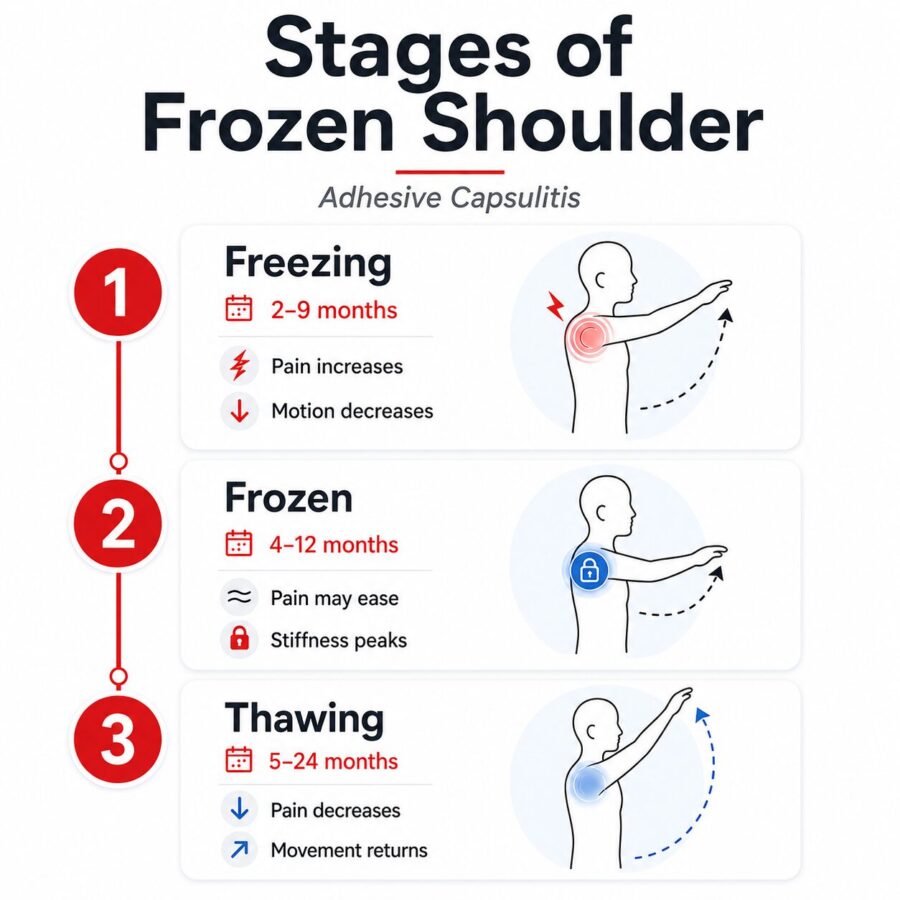
Frozen shoulder often changes in a recognizable sequence: first becoming more painful and restricted, then remaining very stiff, and eventually beginning to loosen. These changes are commonly described as three stages:
- Freezing stage: The shoulder progressively hurts more and moves less. Many people notice pain at night along with increasing difficulty reaching, dressing, or making sudden arm movements. Approximately 2 to 9 Months.
- The frozen phase: Pain does not always stay as intense in this phase, but shoulder motion can be extremely limited. Reaching overhead, outward, or behind the body may remain difficult. 4 to 12 Months.
- Thawing stage: The shoulder begins loosening over time. Progress may be gradual, but increasing motion allows more comfortable use of the arm in work, exercise, and everyday life. 5 to 24 Months.
Recovery does not happen on an exact calendar. You may move through one phase faster than another, and symptoms can overlap. A Union, MO physical therapist can continue adapting treatment as pain decreases, stiffness changes, strength returns, and everyday activity becomes easier.
What Goes Into a Frozen Shoulder Diagnosis?
A frozen shoulder diagnosis usually begins with your symptoms, medical history, and a physical examination.
One important part of the examination is comparing active and passive movement. Your Union, MO physical therapist or healthcare provider may first watch how far you can move the arm yourself, then assess how far the shoulder moves when you relax. Strength, posture, compensations, and the pattern of lost motion may also provide clues.
Frozen shoulder is often diagnosed clinically. However, if your symptoms do not fit the usual pattern or another source of stiffness is suspected, your provider may use X-rays, ultrasound, or MRI to rule out conditions including arthritis and rotator cuff injuries.
How Union, MO Physical Therapy Treats Frozen Shoulder
Frozen shoulder rehab is not about forcing the joint through the same routine at every visit. The challenge is to work within what the shoulder currently tolerates while steadily building toward better mobility and function.
Early in the process, pain may be the main barrier. Later, stiffness may become the bigger problem. As mobility returns, weakness and altered movement habits may need more attention. Your Axes physical therapist in Union, MO can adjust the treatment plan as those priorities change.
Early Treatment: Controlling Pain and Preserving Movement
When pain and irritability are high, therapy may include:
- Low-intensity shoulder mobility work
- Hands-on therapy
- Temporary changes to painful work, exercise, or household activities
- Strategies that help you use the arm without repeatedly aggravating it
Treatment can extend beyond the exercises you perform in the clinic. Your Union, MO therapist may help you find better sleeping positions, modify workouts or job duties, and change the way you approach movements that repeatedly irritate the shoulder.
Improving Range of Motion as Pain Settles
As pain improves, treatment can shift to restoring lost motion. Your physical therapist may use targeted stretches, mobility exercises, and manual therapy to improve movements such as reaching overhead, rotating the arm, or reaching behind your back. Even small gains in motion can make everyday tasks noticeably easier.
Restoring Strength as Motion Returns
Later-stage rehab may look more like progressive strengthening than stretching. Once the shoulder has enough movement to work with, your therapist can begin increasing resistance and difficulty so the muscles supporting the shoulder are prepared for normal lifting and activity.
Helping the Shoulder and Trunk Work Together Again
A stiff shoulder often causes people to shrug, lean, twist, or rely more on the opposite arm. Physical therapy can address these compensations and improve how the shoulder blade, upper back, neck, and trunk work together as normal motion returns.
Returning to Work, Exercise, Sports, and Daily Activities
Later-stage rehab can become more specific to the activities you want to return to, whether that means lifting at work, strength training, golf, throwing, gardening, or overhead tasks. Your Union, MO physical therapist can gradually reintroduce the movements and loads your shoulder needs for those activities.
Why Choose Axes Physical Therapy for Frozen Shoulder Treatment in Union, MO?
Frozen shoulder may take months to resolve. During that time, there is a major difference between simply waiting and having a plan for pain, mobility, strength, and daily activity.
At Axes Physical Therapy in Union, MO, treatment is based on your current symptoms, stage of recovery, functional limitations, and the activities you want to regain.
Individualized care: Exercises, hands-on treatment, activity guidance, and progression can all be modified according to how your shoulder responds.
Stage-appropriate care: Treatment can become more challenging when the shoulder is ready instead of assuming that more aggressive care is always better.
Fast scheduling: Axes can typically schedule new patients in Union, MO within 24 to 48 hours of initial outreach.
Direct Access support: Not sure whether you need a physician referral? Axes can help determine whether your situation qualifies for Direct Access physical therapy in Union, MO.
Help when physical therapy is not the only next step: Not every stiff shoulder should remain solely in physical therapy. When findings point toward another concern, your therapist can help connect the dots between rehabilitation and the medical care you may need next.
Free shoulder injury screenings: If you are not sure what is causing your shoulder pain or where to begin, a free injury screening can help you better understand your options.
Frequently Asked Questions About Frozen Shoulder Treatment in Union, MO
Why is physical therapy used for frozen shoulder?
Physical therapy is commonly used as a primary treatment for frozen shoulder. Treatment can help manage pain, preserve or restore shoulder mobility, rebuild strength, and improve your ability to perform everyday activities. The specific approach should change based on how painful and restricted the shoulder is.
How can I recover from frozen shoulder faster?
Frozen shoulder does not have a dependable overnight fix. The condition usually improves gradually, and rehabilitation needs to respect that timeline. Pushing a painful shoulder aggressively in an attempt to speed things up can sometimes make symptoms worse rather than producing faster progress.
Is stretching good for frozen shoulder?
Stretching can be useful, but the answer is not simply “more is better.” During a highly painful stage, gentle movement may be more appropriate than forceful stretching. Once pain settles and stiffness becomes the dominant problem, your therapist may gradually increase the intensity.
Will frozen shoulder eventually improve?
Many frozen shoulders gradually improve without surgery, although the process may take a long time. Physical therapy does not simply wait for that recovery to happen. It can help you manage symptoms and work on mobility, strength, and function along the way.
Can certain exercises make frozen shoulder worse?
The goal is not to prove how much discomfort you can push through. If an exercise repeatedly causes a significant flare that lasts well beyond the session, it may need to be modified. Your therapist can help match the movement and intensity to your current stage.
Can frozen shoulder come back?
A second episode in the identical shoulder is not common, but frozen shoulder can later appear in the other arm. Medical conditions associated with adhesive capsulitis may also influence future risk.
Can frozen shoulder be treated without surgery?
For most patients, no. Frozen shoulder is usually managed without an operation. If the shoulder remains severely painful or restricted after an appropriate period of conservative care, an orthopedic specialist may discuss procedural or surgical options.
When should I see a physical therapist in Union, MO for shoulder stiffness?
Consider an evaluation if your shoulder is becoming progressively harder to move, pain is interfering with sleep, or normal activities such as dressing, reaching, lifting, or grooming are getting harder. Because several shoulder conditions can cause pain and stiffness, an evaluation can also help determine whether frozen shoulder is actually the problem.
Begin Your Frozen Shoulder Recovery in Union, MO
Frozen shoulder can take time to improve, but you do not have to wait it out on your own. Physical therapy in Union, MO can help reduce pain, improve mobility and strength, and help you return to work, exercise, sports, and everyday activities as your shoulder recovers.
The goal is not to force every frozen shoulder through the same template. Axes can continually adjust treatment according to where your shoulder is in the recovery process.
Ready to take the next step? Request an appointment online, reach out to the Axes location nearest you, or start with a free injury screening.