Treatment for Frozen Shoulder in Mapaville, MO. Frozen shoulder can turn ordinary shoulder movement into a daily negotiation. You may notice trouble reaching into a cabinet, pulling on clothing, lifting at work, exercising, golfing, or completing repetitive tasks. As stiffness increases, even finding a comfortable sleeping position may become frustrating.
The good news is that most frozen shoulder cases improve without surgery. At Axes Physical Therapy in Mapaville, MO, we create personalized treatment plans to reduce pain, restore shoulder mobility and strength, and help you regain function as your shoulder moves through the different stages of recovery. Our focus is getting you back to the activities you love and helping you return to work, sports, exercise, and daily life with confidence.
When shoulder stiffness starts affecting normal life, getting an evaluation does not always require another appointment first. Many people in Mapaville, MO qualify to begin physical therapy without a physician referral through Missouri Direct Access, and Axes typically offers scheduling within 24 to 48 hours after initial outreach.
Getting started can be as simple as requesting an appointment. You can also call a nearby Axes Physical Therapy location or come in for a free injury screening.
Some shoulder symptoms should be medically evaluated promptly rather than treated as routine stiffness. These include pain after an acute injury, severe swelling, visible deformity, major weakness, numbness or tingling, or difficulty moving the arm at all.
On this page, you will learn about:
- Why adhesive capsulitis causes the shoulder to become stiff and difficult to move
- How frozen shoulder changes during the freezing, frozen, and thawing stages
- Why treatment may look different in early, middle, and later recovery
- How recovery may progress and what you can do outside physical therapy visits
What Does Frozen Shoulder Mean?
The stiffness of frozen shoulder does not come only from weak or sore muscles. Much of the restriction occurs in the tissue surrounding the joint itself. That tissue, known as the joint capsule, normally has enough flexibility to allow broad shoulder movement. With adhesive capsulitis, the capsule thickens and tightens.
As that happens, the shoulder gradually loses range of motion. Reaching overhead, reaching behind your back, or rotating your arm outward can become especially difficult.
One feature that helps distinguish frozen shoulder from many other shoulder problems is that both active and passive range of motion become limited. That means you may have trouble lifting or rotating your arm yourself, and the shoulder may still resist movement even when a physical therapist or another person tries to move it for you.
A common frozen shoulder pattern begins with noticeable loss of outward rotation. Later, the limitation may become obvious during tasks that require reaching overhead, fastening clothing behind the body, or placing the hand behind the back.
Common Symptoms of Frozen Shoulder
The condition commonly develops gradually. Pain may be the first obvious problem, with stiffness and loss of motion becoming more noticeable over the following weeks or months.
- A persistent ache or deeper pain within the shoulder
- Progressively worsening shoulder stiffness
- Pain that is worse at night or interferes with sleep
- Trouble reaching shelves, cabinets, or other overhead areas
- Difficulty placing the hand behind the body
- Shoulder restriction that makes dressing uncomfortable
- Reduced shoulder function during routine household and personal-care activities
- A shoulder that feels restricted even when someone else moves your arm
Pain and stiffness do not always move in the same direction. During some stages, pain may begin to settle while the shoulder remains very stiff. That changing pattern is one reason treatment should be adjusted over time, rather than following the same routine from beginning to end.
You may still be able to complete many activities with frozen shoulder, but not in the same way. Limited joint motion can lead to altered lifting mechanics, extra trunk movement, shoulder shrugging, and other substitutions, particularly during overhead work, exercise, and sports.
Possible Causes of Frozen Shoulder
Frozen shoulder can develop with or without an identifiable trigger. Some people have no preceding injury at all, while others first experience stiffness after healing from another shoulder problem or spending an extended period using the arm less than usual.
Situations associated with frozen shoulder include:
- Without a clear cause: Symptoms can gradually appear even when there has been no obvious injury.
- After an injury or surgery: Pain and healing after surgery, fracture, or another shoulder injury can temporarily limit normal movement.
- Following prolonged reduced use: Keeping the arm relatively still for an extended period can increase stiffness.
Who Commonly Develops Frozen Shoulder?
Anyone can develop shoulder stiffness, but frozen shoulder is especially associated with certain groups. The condition occurs most often during middle age and has stronger associations with health conditions including diabetes and thyroid disease.
The Three Stages of Frozen Shoulder
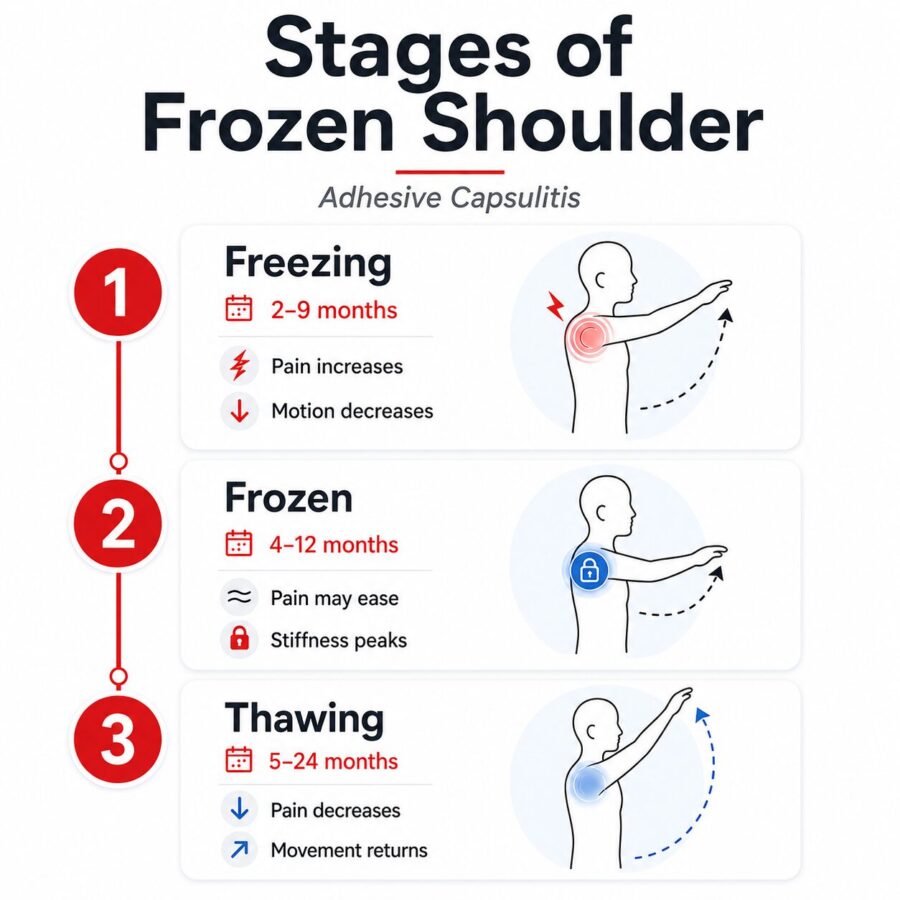
The course of frozen shoulder is usually divided into three broad stages. These phases do not follow an identical timeline for everyone, and the balance between pain and stiffness changes as the shoulder moves through them:
- Stage 1: Freezing: Pain increases while shoulder movement gradually becomes more limited. Night pain is common, and reaching or sudden movements may be especially uncomfortable. Typical Duration: 2 to 9 Months.
- The frozen phase: For some people, this stage feels less painful than the first but more mechanically restrictive. The shoulder may simply refuse to move far enough for many normal tasks. Approximately 4 to 12 Months.
- Stage 3: Thawing: The direction finally begins to reverse. Range of motion slowly increases, stiffness eases, and tasks that had become difficult start becoming more manageable. 5 to 24 Months.
The stages are useful for understanding frozen shoulder, but they are not deadlines. Your shoulder may improve sooner or take longer in certain phases. Physical therapy can support progress throughout recovery by working on the mobility, strength, and function available at that point.
What Goes Into a Frozen Shoulder Diagnosis?
A frozen shoulder diagnosis usually begins with your symptoms, medical history, and a physical examination.
A Mapaville, MO provider evaluating a stiff shoulder is looking for a pattern, not simply one painful motion. They may compare multiple directions of movement, assess strength and posture, and determine whether passive motion is restricted along with active motion.
Imaging may play more of a supporting role than a diagnostic one. Your provider might recommend an X-ray, MRI, or ultrasound when they need to determine whether arthritis, a rotator cuff injury, or another problem is contributing to your loss of motion.
Physical Therapy for Frozen Shoulder in Mapaville, MO
Frozen shoulder rehab is not about forcing the joint through the same routine at every visit. The challenge is to work within what the shoulder currently tolerates while steadily building toward better mobility and function.
Your Mapaville, MO Axes physical therapist can change the emphasis of treatment as the shoulder changes. A highly painful shoulder may need gentle movement and symptom management. A less painful but very stiff shoulder may tolerate more mobility work. Later, strengthening and normal movement patterns may become the focus.
Early Treatment: Controlling Pain and Preserving Movement
The early phase of rehabilitation may emphasize:
- Low-intensity shoulder mobility work
- Hands-on techniques selected for your current symptoms
- Adjustments that reduce unnecessary shoulder irritation
- Strategies that help you use the arm without repeatedly aggravating it
A large part of early frozen shoulder management happens between appointments. Your physical therapist can help you make practical changes to sleep, work, exercise, dressing, reaching, and other daily activities so you are not constantly provoking the shoulder.
Restoring Shoulder Mobility
Later in recovery, the question may shift from “How do we keep this shoulder from flaring?” to “How do we regain the movement that is still missing?” Treatment may become more deliberate about overhead reach, rotation, and behind-the-back motion through stretching, exercises, and manual therapy.
Building a Stronger, More Capable Shoulder
Regaining range of motion is not the end of rehabilitation. After spending months moving less, the shoulder and surrounding muscles may need to rebuild strength. Your program can gradually challenge the rotator cuff, scapular muscles, and upper back as the joint becomes more comfortable.
Correcting Compensatory Movement Patterns
The body is good at finding workarounds. If the shoulder will not move enough, the neck, shoulder blade, trunk, or opposite arm may take over. Part of rehabilitation is restoring more efficient movement so these areas are not doing work the shoulder should eventually handle again.
Returning to Work, Exercise, Sports, and Daily Activities
Once basic motion and strength have improved, rehabilitation can become much more specific. Someone returning to golf needs different preparation than someone lifting equipment at work or resuming strength training. Your Mapaville, MO therapist can progressively rebuild the exact movements and loads your goals require.
Why Choose Axes Physical Therapy for Frozen Shoulder Treatment in Mapaville, MO?
You cannot rush every stage of frozen shoulder, but you can still be active about recovery. The right plan can help you protect an irritable shoulder, address stiffness when it becomes appropriate, and rebuild function as movement returns.
Treatment at Axes Physical Therapy begins with the shoulder in front of us. The plan can reflect your current pain, mobility, strength, limitations, recovery stage, and personal goals rather than following a generic frozen shoulder protocol.
Personalized treatment: The plan can change as the shoulder becomes less painful, more mobile, stronger, or capable of handling more activity.
Progression based on symptoms: Treatment intensity can progress with your shoulder instead of forcing the same exercises from beginning to end.
Fast scheduling: Axes generally offers initial appointments within 24 to 48 hours of outreach, helping you avoid a long delay before having the shoulder evaluated.
Help understanding Missouri referral rules: Missouri law allows many patients to begin physical therapy directly, but individual circumstances can vary. Axes can help you understand what applies to you.
Coordination with other healthcare providers: Not every stiff shoulder should remain solely in physical therapy. When findings point toward another concern, your therapist can help connect the dots between rehabilitation and the medical care you may need next.
Complimentary injury screenings: If you are not sure what is causing your shoulder pain or where to begin, a free injury screening can help you better understand your options.
Frozen Shoulder Treatment FAQs in Mapaville, MO
Does physical therapy work for frozen shoulder?
Physical therapy is commonly used as a primary treatment for frozen shoulder. Treatment can help manage pain, preserve or restore shoulder mobility, rebuild strength, and improve your ability to perform everyday activities. The specific approach should change based on how painful and restricted the shoulder is.
Is there a quick way to get rid of frozen shoulder?
Frozen shoulder does not have a dependable overnight fix. The condition usually improves gradually, and rehabilitation needs to respect that timeline. Pushing a painful shoulder aggressively in an attempt to speed things up can sometimes make symptoms worse rather than producing faster progress.
Should frozen shoulder be stretched aggressively?
A frozen shoulder often needs mobility work, but timing matters. Early in the condition, pushing hard into painful motion can irritate the joint. Later, when the shoulder is less reactive, more deliberate stretching may be appropriate.
Does frozen shoulder resolve naturally?
Yes, frozen shoulder often improves with time and conservative care. That does not mean every month of recovery needs to be passive. Therapy can help address the limitations you are experiencing at each stage.
What should I not do with frozen shoulder?
The goal is not to prove how much discomfort you can push through. If an exercise repeatedly causes a significant flare that lasts well beyond the session, it may need to be modified. Your therapist can help match the movement and intensity to your current stage.
Can frozen shoulder affect the other shoulder later?
Frozen shoulder does not usually keep recurring in the same joint, but having it once does not guarantee the other shoulder will never be affected. Individual health factors can influence that likelihood.
Will I need surgery for frozen shoulder?
Surgery is not the usual first-line treatment for frozen shoulder. Most people begin with conservative care, including physical therapy. Procedures such as manipulation under anesthesia or arthroscopic treatment are generally considered only when significant symptoms persist despite nonsurgical treatment.
When should shoulder stiffness be evaluated in Mapaville, MO?
You do not have to wait until the shoulder is nearly immobile. If motion is steadily decreasing, sleep is becoming difficult, or everyday activities are getting harder, a Mapaville, MO physical therapy evaluation may help identify what is happening. Several shoulder problems can look similar at first.
Get Help for Frozen Shoulder in Mapaville, MO
A frozen shoulder rarely transforms overnight. Progress tends to happen in stages. Working with a Mapaville, MO physical therapist gives you a plan for each part of that process, from managing pain and stiffness to rebuilding the strength and movement needed for daily life.
The goal is not to force every frozen shoulder through the same template. Axes can continually adjust treatment according to where your shoulder is in the recovery process.
Request an appointment, contact your nearest Axes Physical Therapy location, or schedule a free injury screening to get started.