Sappington, MO Frozen Shoulder Treatment. Frozen shoulder can make familiar movements suddenly difficult. Reaching overhead, putting on a jacket, swinging a golf club, lifting weights, handling tools, or doing repetitive work can become painful as the shoulder stiffens and loses motion. Even sleeping comfortably is a problem for many people.
The good news is that most frozen shoulder cases improve without surgery. At Axes Physical Therapy in Sappington, MO, we create personalized treatment plans to reduce pain, restore shoulder mobility and strength, and help you regain function as your shoulder moves through the different stages of recovery. Our focus is getting you back to the activities you love and helping you return to work, sports, exercise, and daily life with confidence.
When shoulder stiffness starts affecting normal life, getting an evaluation does not always require another appointment first. Many people in Sappington, MO qualify to begin physical therapy without a physician referral through Missouri Direct Access, and Axes typically offers scheduling within 24 to 48 hours after initial outreach.
Not sure which next step makes sense? You can schedule a free injury screening, reach out to your nearest Axes clinic, or request a physical therapy appointment online.
Seek prompt medical evaluation when shoulder pain follows an acute injury or occurs with severe swelling, visible deformity, significant weakness, numbness, tingling, or an inability to move the arm normally.
This page covers:
- What changes inside the shoulder when frozen shoulder develops
- The three general stages of frozen shoulder and how symptoms differ between them
- How physical therapy for frozen shoulder changes as symptoms change
- What to expect during recovery and how to handle daily activity between appointments
What Is Frozen Shoulder?
To understand frozen shoulder, it helps to picture the ball-and-socket joint sitting inside a flexible envelope of tissue. This is the joint capsule. In adhesive capsulitis, changes to that capsule make it thicker and less flexible, which can progressively restrict normal shoulder motion.
A tightening capsule does not limit every movement equally. Many people first notice that certain directions, particularly overhead reach, behind-the-back reach, and outward rotation, become much more difficult than they used to be.
A physical therapist evaluating possible frozen shoulder will pay attention not only to what you can do yourself, but also to how far the shoulder moves when you relax and someone else moves the arm. In adhesive capsulitis, both forms of range of motion are typically reduced.
Not every direction becomes stiff at exactly the same rate. External rotation is commonly affected early, especially when the elbow stays close to the body and the forearm rotates outward. Over time, overhead reaching and behind-the-back movement may also become increasingly difficult.
Signs You May Have Frozen Shoulder
Symptoms generally build over time, sometimes beginning with an aching shoulder that becomes progressively harder to move.
- A deep or aching pain in the shoulder
- Progressively worsening shoulder stiffness
- Shoulder discomfort that becomes especially noticeable when trying to sleep
- Trouble reaching shelves, cabinets, or other overhead areas
- Difficulty placing the hand behind the body
- Shoulder restriction that makes dressing uncomfortable
- Difficulty with grooming, driving, lifting, or household tasks
- A shoulder that feels restricted even when someone else moves your arm
Improvement in pain does not necessarily mean normal motion has returned. In the middle portion of frozen shoulder, discomfort can decrease while stiffness remains substantial. Physical therapy therefore needs to respond to the shoulder’s current limitations rather than follow one fixed program.
A stiff shoulder changes more than the shoulder itself. When the joint cannot provide enough motion, the body may find other ways to complete the task, such as shrugging, leaning sideways, rotating the trunk, or relying more heavily on the other arm. Those compensations can show up during work, exercise, sports, and daily life.
How Does Frozen Shoulder Start?
There is not always a clear reason why frozen shoulder develops. Some cases appear without an obvious injury or trigger, while others develop after something has limited normal shoulder movement for a period of time.
Frozen shoulder may appear in situations such as:
- Without an obvious trigger: Symptoms can gradually appear even when there has been no obvious injury.
- After an injury or surgery: The arm may be used less during recovery from a fracture, operation, or other shoulder condition, giving stiffness an opportunity to develop.
- When normal shoulder movement has been restricted: Shoulder stiffness can increase when the joint has not moved through its usual range for a prolonged period.
Who Commonly Develops Frozen Shoulder?
Among people in Sappington, MO, a history of diabetes or thyroid problems may increase the likelihood of frozen shoulder. The condition is also most frequently diagnosed in middle-aged adults.
How Does Frozen Shoulder Progress?
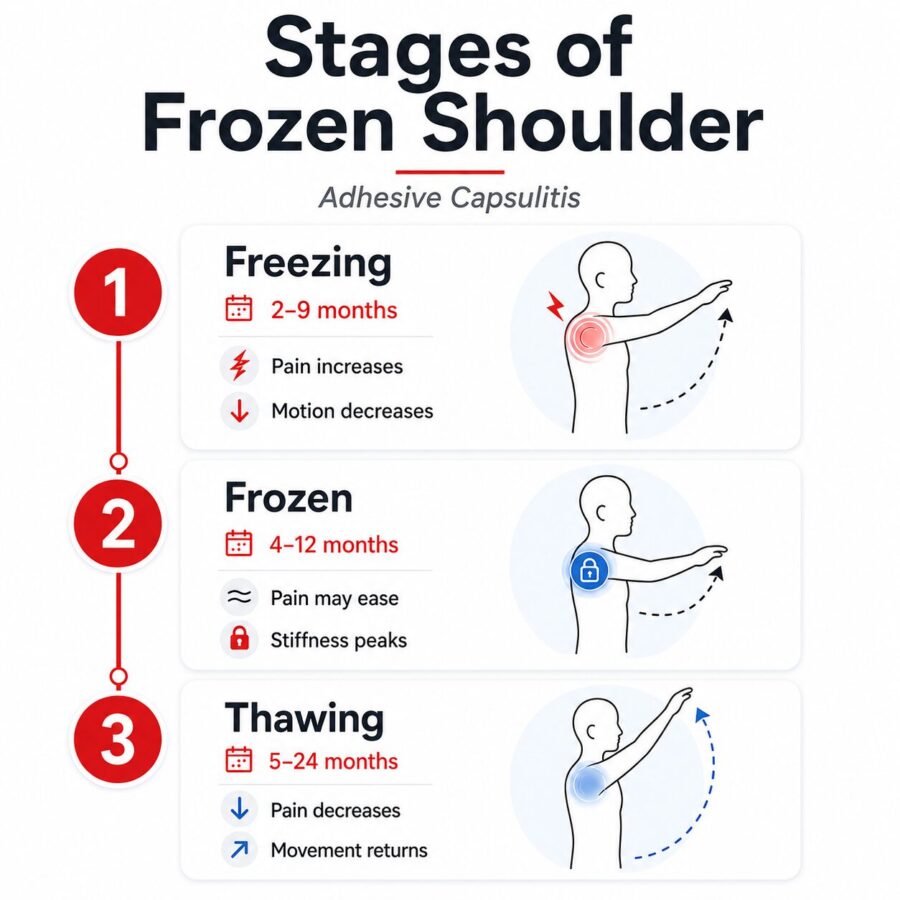
Frozen shoulder often changes in a recognizable sequence: first becoming more painful and restricted, then remaining very stiff, and eventually beginning to loosen. These changes are commonly described as three stages:
- Stage 1: Freezing: Motion begins to disappear during this stage, often while pain is still increasing. Even simple reaching may hurt, and nighttime symptoms are common. 2 to 9 Months.
- Frozen stage: Pain does not always stay as intense in this phase, but shoulder motion can be extremely limited. Reaching overhead, outward, or behind the body may remain difficult. Approximately 4 to 12 Months.
- Stage 3: Thawing: The direction finally begins to reverse. Range of motion slowly increases, stiffness eases, and tasks that had become difficult start becoming more manageable. Approximately 5 to 24 Months.
Recovery does not happen on an exact calendar. You may move through one phase faster than another, and symptoms can overlap. A Sappington, MO physical therapist can continue adapting treatment as pain decreases, stiffness changes, strength returns, and everyday activity becomes easier.
How Frozen Shoulder Is Evaluated in Sappington, MO
A frozen shoulder diagnosis usually begins with your symptoms, medical history, and a physical examination.
Your Sappington, MO physical therapist or healthcare provider will assess how far you can move the shoulder yourself and how far it can be moved passively. They may also evaluate shoulder strength, posture, movement patterns, and which directions are especially restricted. A characteristic pattern of mobility loss can help distinguish adhesive capsulitis from other shoulder conditions.
Imaging is not always necessary to diagnose frozen shoulder. X-rays, MRI, or ultrasound may be used when your provider needs to rule out another source of pain or stiffness, such as arthritis or a rotator cuff injury.
Frozen Shoulder Rehabilitation in Sappington, MO
A frozen shoulder program should fit the shoulder you walk in with today, not the shoulder you had three months ago or hope to have three months from now. Treatment can address current limitations while preparing you for the next stage of recovery.
The shoulder does not need the same thing at every stage. When pain is high, aggressive mobility work may not be appropriate. When pain settles, stiffness may demand more attention. Once mobility begins returning, strength and movement quality often become more important. Your Axes therapist in Sappington, MO can modify the plan accordingly.
Early Treatment: Controlling Pain and Preserving Movement
When pain and irritability are high, therapy may include:
- Low-intensity shoulder mobility work
- Hands-on techniques selected for your current symptoms
- Adjustments that reduce unnecessary shoulder irritation
- Strategies that help you use the arm without repeatedly aggravating it
Treatment can extend beyond the exercises you perform in the clinic. Your Sappington, MO therapist may help you find better sleeping positions, modify workouts or job duties, and change the way you approach movements that repeatedly irritate the shoulder.
Helping the Shoulder Move More Freely
As pain improves, treatment can shift to restoring lost motion. Your physical therapist may use targeted stretches, mobility exercises, and manual therapy to improve movements such as reaching overhead, rotating the arm, or reaching behind your back. Even small gains in motion can make everyday tasks noticeably easier.
Strengthening After Frozen Shoulder
As mobility returns, strengthening may focus on the rotator cuff, shoulder blade muscles, upper back, and other muscles that support normal arm movement. Resistance and exercise difficulty can increase gradually as your shoulder becomes more comfortable and capable.
Correcting Compensatory Movement Patterns
The body is good at finding workarounds. If the shoulder will not move enough, the neck, shoulder blade, trunk, or opposite arm may take over. Part of rehabilitation is restoring more efficient movement so these areas are not doing work the shoulder should eventually handle again.
Preparing for Work, Exercise, Sports, and Everyday Life
The final stage is not simply about achieving a number on a range-of-motion test. It is about making the shoulder useful again. That may mean lifting at work, pressing weights overhead, swinging a golf club, throwing, gardening, or performing repetitive job tasks. Therapy can be tailored toward those demands.
What Axes Offers Patients With Frozen Shoulder in Sappington, MO
Recovery often requires patience, but that does not mean sitting back and hoping the shoulder eventually loosens. A structured rehabilitation plan gives you a way to manage symptoms and work toward function throughout the process.
Treatment at Axes Physical Therapy begins with the shoulder in front of us. The plan can reflect your current pain, mobility, strength, limitations, recovery stage, and personal goals rather than following a generic frozen shoulder protocol.
Treatment tailored to your recovery: What you do early in treatment does not have to be what you are still doing months later. Your therapist can continually adjust the program.
Treatment that changes with the stage: Treatment can become more challenging when the shoulder is ready instead of assuming that more aggressive care is always better.
Fast scheduling: Axes can typically schedule new patients in Sappington, MO within 24 to 48 hours of initial outreach.
Help understanding Missouri referral rules: Axes can help you understand whether you can begin physical therapy in Sappington, MO without a physician referral based on your location and individual situation.
Coordinated care: Not every stiff shoulder should remain solely in physical therapy. When findings point toward another concern, your therapist can help connect the dots between rehabilitation and the medical care you may need next.
Free shoulder injury screenings: You do not need to know exactly what is wrong before contacting Axes. A free injury screening can be a simple starting point if you are unsure whether your symptoms sound like frozen shoulder or something else.
Frozen Shoulder Treatment FAQs in Sappington, MO
Can physical therapy help frozen shoulder?
Physical therapy is one of the main nonsurgical approaches used for frozen shoulder. Depending on your stage, the emphasis may be pain management, preserving movement, regaining mobility, rebuilding strength, or returning to normal activity. The program should evolve instead of remaining identical throughout recovery.
How can I recover from frozen shoulder faster?
There is no single exercise, stretch, injection, or therapy technique that guarantees immediate recovery. A more realistic goal is to keep making appropriate progress as the condition changes, without repeatedly provoking the shoulder in the process.
How much should I stretch a frozen shoulder?
Yes, stretching is commonly part of treatment. The important question is how hard, how often, and in which direction. Those decisions should reflect your current pain level and stage of recovery rather than a one-size-fits-all rule.
Does frozen shoulder resolve naturally?
Many frozen shoulders gradually improve without surgery, although the process may take a long time. Physical therapy does not simply wait for that recovery to happen. It can help you manage symptoms and work on mobility, strength, and function along the way.
What exercises should I avoid with frozen shoulder?
Avoid turning your rehabilitation into a contest to see how much pain you can tolerate. Exercises or stretches that cause substantial or lasting increases in pain may be too aggressive for your current stage. Your physical therapist can help determine which movements are appropriate and when to progress them.
Can frozen shoulder come back?
A second episode in the identical shoulder is not common, but frozen shoulder can later appear in the other arm. Medical conditions associated with adhesive capsulitis may also influence future risk.
When is surgery considered for frozen shoulder?
The majority of frozen shoulder cases are treated nonsurgically. Physical therapy and other conservative approaches are generally used first, with more invasive treatment reserved for cases that remain severely limited.
How do I know when to see a physical therapist for a stiff shoulder?
A shoulder that continues becoming stiffer deserves attention, particularly when the change begins affecting sleep, dressing, lifting, reaching, or personal care. An evaluation can help determine whether the pattern fits frozen shoulder or another condition.
Take the Next Step With Frozen Shoulder Treatment in Sappington, MO
The shoulder may need time, but recovery can still have direction. Physical therapy can help you work through changing symptoms and gradually return to lifting, exercise, work duties, sports, hobbies, and normal everyday movement.
At Axes Physical Therapy, the plan can change with the shoulder. What you need during a painful early stage may be very different from what you need once movement starts returning.
You can begin by contacting a nearby Axes Physical Therapy clinic. You can also request an appointment online or schedule a free injury screening.