
Madison, IL Frozen Shoulder Treatment. Frozen shoulder often starts changing the way you use your arm long before you stop using it altogether. Everyday movements such as dressing, reaching, lifting, working with tools, exercising, or playing golf may become painful or restricted, and nighttime discomfort can make sleep difficult.
The good news is that most frozen shoulder cases improve without surgery. At Axes Physical Therapy in Madison, IL, we create personalized treatment plans to reduce pain, restore shoulder mobility and strength, and help you regain function as your shoulder moves through the different stages of recovery. Our focus is getting you back to the activities you love and helping you return to work, sports, exercise, and daily life with confidence.
When shoulder stiffness starts affecting normal life, getting an evaluation does not always require another appointment first. Many people in Madison, IL qualify to begin physical therapy without a physician referral through Missouri Direct Access, and Axes typically offers scheduling within 24 to 48 hours after initial outreach.
Getting started can be as simple as requesting an appointment. You can also call a nearby Axes Physical Therapy location or come in for a free injury screening.
Some shoulder symptoms should be medically evaluated promptly rather than treated as routine stiffness. These include pain after an acute injury, severe swelling, visible deformity, major weakness, numbness or tingling, or difficulty moving the arm at all.
This page covers:
- What frozen shoulder is and why shoulder movement becomes restricted
- The freezing, frozen, and thawing stages of the condition
- How physical therapy for frozen shoulder changes as symptoms change
- What recovery can look like and how to manage your shoulder between visits
What Is Frozen Shoulder?
Inside a healthy shoulder, the ball-and-socket joint is surrounded by a flexible sleeve of tissue called the joint capsule. Frozen shoulder, or adhesive capsulitis, develops when that capsule becomes thicker and tighter. The result is increasing stiffness, pain, and less freedom of movement within the joint.
As that happens, the shoulder gradually loses range of motion. Reaching overhead, reaching behind your back, or rotating your arm outward can become especially difficult.
A physical therapist evaluating possible frozen shoulder will pay attention not only to what you can do yourself, but also to how far the shoulder moves when you relax and someone else moves the arm. In adhesive capsulitis, both forms of range of motion are typically reduced.
External rotation, such as rotating your forearm away from your body with your elbow near your side, is often one of the first and most noticeable movements to become restricted. Reaching overhead and behind your back commonly become more difficult as the condition progresses.
Signs You May Have Frozen Shoulder
Symptoms generally build over time, sometimes beginning with an aching shoulder that becomes progressively harder to move.
- Shoulder pain that feels dull, deep, or aching
- Progressively worsening shoulder stiffness
- Shoulder discomfort that becomes especially noticeable when trying to sleep
- Difficulty reaching overhead
- Trouble reaching behind your back
- Pain or stiffness when getting dressed
- Reduced shoulder function during routine household and personal-care activities
- Stiffness that remains when another person tries to move the shoulder
Pain and stiffness do not always move in the same direction. During some stages, pain may begin to settle while the shoulder remains very stiff. That changing pattern is one reason treatment should be adjusted over time, rather than following the same routine from beginning to end.
You may still be able to complete many activities with frozen shoulder, but not in the same way. Limited joint motion can lead to altered lifting mechanics, extra trunk movement, shoulder shrugging, and other substitutions, particularly during overhead work, exercise, and sports.
Possible Causes of Frozen Shoulder
There is not always a clear reason why frozen shoulder develops. Some cases appear without an obvious injury or trigger, while others develop after something has limited normal shoulder movement for a period of time.
The condition can develop in several different circumstances:
- Spontaneously: Symptoms can gradually appear even when there has been no obvious injury.
- During recovery from another shoulder problem: A fracture, surgery, or another shoulder condition may reduce movement while the shoulder heals.
- After a period of limited movement: Shoulder stiffness can increase when the joint has not moved through its usual range for a prolonged period.
Who Commonly Develops Frozen Shoulder?
Certain health conditions are associated with a higher risk of frozen shoulder. It is more common among people in Madison, IL with diabetes and thyroid disorders, and it occurs most often in middle-aged adults.
How Does Frozen Shoulder Progress?
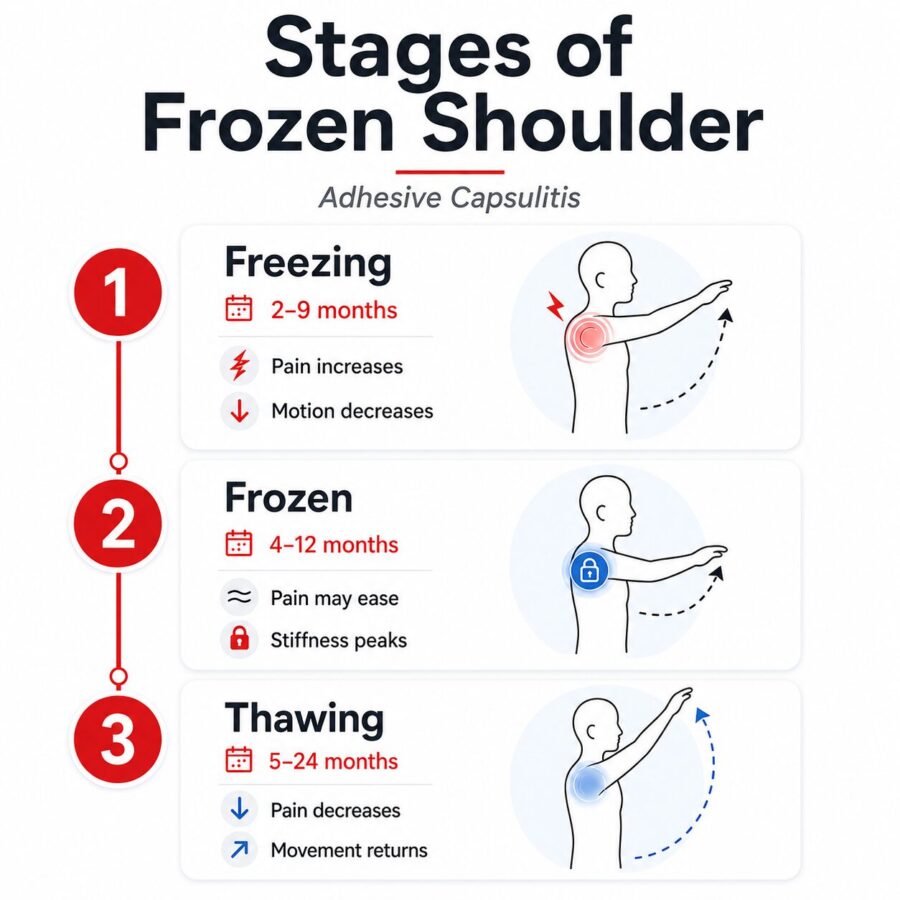
Frozen shoulder typically progresses through three stages. The timing varies, but each stage tends to have a different mix of pain and stiffness:
- Freezing stage: Motion begins to disappear during this stage, often while pain is still increasing. Even simple reaching may hurt, and nighttime symptoms are common. Approximately 2 to 9 Months.
- The frozen phase: The shoulder may become less painful even though it remains markedly restricted. Daily tasks are often limited more by stiffness than by discomfort at this point. Typical Duration: 4 to 12 Months.
- Stage 3: Thawing: The direction finally begins to reverse. Range of motion slowly increases, stiffness eases, and tasks that had become difficult start becoming more manageable. 5 to 24 Months.
These timelines are broad estimates, and recovery can happen sooner. Physical therapy in Madison, IL can help you make progress throughout each stage by improving shoulder mobility, strength, and function and helping you return to normal activities as your symptoms improve.
Diagnosing Frozen Shoulder in Madison, IL
A frozen shoulder diagnosis usually begins with your symptoms, medical history, and a physical examination.
Your Madison, IL physical therapist or healthcare provider will assess how far you can move the shoulder yourself and how far it can be moved passively. They may also evaluate shoulder strength, posture, movement patterns, and which directions are especially restricted. A characteristic pattern of mobility loss can help distinguish adhesive capsulitis from other shoulder conditions.
A scan is not automatically required when the examination strongly suggests frozen shoulder. Imaging becomes more useful when another condition could explain the symptoms. Depending on the situation, X-rays, MRI, or ultrasound may help evaluate problems such as arthritis or a rotator cuff injury.
How Madison, IL Physical Therapy Treats Frozen Shoulder
A frozen shoulder program should fit the shoulder you walk in with today, not the shoulder you had three months ago or hope to have three months from now. Treatment can address current limitations while preparing you for the next stage of recovery.
Think of treatment priorities as a moving target. Pain may dominate the freezing stage, stiffness may take over in the frozen stage, and later recovery may reveal weakness or compensations that were less obvious before. Improving mobility is only one part of that progression.
Keeping an Irritable Shoulder Moving Without Overdoing It
Early treatment may focus on:
- Gentle range-of-motion exercises
- Hands-on therapy
- Activity modifications
- Ways to preserve useful arm movement without causing repeated symptom flares
Your Madison, IL physical therapist may also help with sleeping positions, work tasks, exercise modifications, and other everyday movements that have become uncomfortable.
Helping the Shoulder Move More Freely
When the shoulder is less painful, mobility work can take on a larger role. Your therapist may use a combination of specific stretches, active mobility exercises, and manual therapy to work on the directions that remain limited. A few additional degrees of movement can sometimes make dressing, grooming, or reaching considerably easier.
Rebuilding Shoulder Strength
As mobility returns, strengthening may focus on the rotator cuff, shoulder blade muscles, upper back, and other muscles that support normal arm movement. Resistance and exercise difficulty can increase gradually as your shoulder becomes more comfortable and capable.
Correcting Compensatory Movement Patterns
A stiff shoulder often causes people to shrug, lean, twist, or rely more on the opposite arm. Physical therapy can address these compensations and improve how the shoulder blade, upper back, neck, and trunk work together as normal motion returns.
Returning the Shoulder to Real-World Demands
Once basic motion and strength have improved, rehabilitation can become much more specific. Someone returning to golf needs different preparation than someone lifting equipment at work or resuming strength training. Your Madison, IL therapist can progressively rebuild the exact movements and loads your goals require.
What Axes Offers Patients With Frozen Shoulder in Madison, IL
You cannot rush every stage of frozen shoulder, but you can still be active about recovery. The right plan can help you protect an irritable shoulder, address stiffness when it becomes appropriate, and rebuild function as movement returns.
At Axes Physical Therapy in Madison, IL, treatment is based on your current symptoms, stage of recovery, functional limitations, and the activities you want to regain.
Personalized treatment: The plan can change as the shoulder becomes less painful, more mobile, stronger, or capable of handling more activity.
Care matched to the shoulder’s current tolerance: Treatment intensity can progress with your shoulder instead of forcing the same exercises from beginning to end.
Fast scheduling: Axes generally offers initial appointments within 24 to 48 hours of outreach, helping you avoid a long delay before having the shoulder evaluated.
Help understanding Missouri referral rules: Your team can explain whether you can start treatment without first seeing a physician and help you navigate the appropriate next step.
Coordination with other healthcare providers: Physical therapists also need to recognize when another provider should be involved. If your examination suggests imaging, orthopedic care, an injection consultation, or another medical service may be useful, Axes can help guide you forward.
No-cost injury screenings: If you are not sure what is causing your shoulder pain or where to begin, a free injury screening can help you better understand your options.
Questions Patients Ask About Frozen Shoulder in Madison, IL
Can physical therapy help frozen shoulder?
Physical therapy is commonly used as a primary treatment for frozen shoulder. Treatment can help manage pain, preserve or restore shoulder mobility, rebuild strength, and improve your ability to perform everyday activities. The specific approach should change based on how painful and restricted the shoulder is.
How can I recover from frozen shoulder faster?
Frozen shoulder does not have a dependable overnight fix. The condition usually improves gradually, and rehabilitation needs to respect that timeline. Pushing a painful shoulder aggressively in an attempt to speed things up can sometimes make symptoms worse rather than producing faster progress.
Is stretching good for frozen shoulder?
Yes, stretching is commonly part of treatment. The important question is how hard, how often, and in which direction. Those decisions should reflect your current pain level and stage of recovery rather than a one-size-fits-all rule.
Does frozen shoulder go away on its own?
Yes, frozen shoulder often improves with time and conservative care. That does not mean every month of recovery needs to be passive. Therapy can help address the limitations you are experiencing at each stage.
What should I not do with frozen shoulder?
Avoid turning your rehabilitation into a contest to see how much pain you can tolerate. Exercises or stretches that cause substantial or lasting increases in pain may be too aggressive for your current stage. Your physical therapist can help determine which movements are appropriate and when to progress them.
Can frozen shoulder come back?
Frozen shoulder does not usually keep recurring in the same joint, but having it once does not guarantee the other shoulder will never be affected. Individual health factors can influence that likelihood.
Can frozen shoulder be treated without surgery?
The majority of frozen shoulder cases are treated nonsurgically. Physical therapy and other conservative approaches are generally used first, with more invasive treatment reserved for cases that remain severely limited.
When should shoulder stiffness be evaluated in Madison, IL?
Consider an evaluation if your shoulder is becoming progressively harder to move, pain is interfering with sleep, or normal activities such as dressing, reaching, lifting, or grooming are getting harder. Because several shoulder conditions can cause pain and stiffness, an evaluation can also help determine whether frozen shoulder is actually the problem.
Start Moving Forward From Frozen Shoulder in Madison, IL
A frozen shoulder rarely transforms overnight. Progress tends to happen in stages. Working with a Madison, IL physical therapist gives you a plan for each part of that process, from managing pain and stiffness to rebuilding the strength and movement needed for daily life.
The goal is not to force every frozen shoulder through the same template. Axes can continually adjust treatment according to where your shoulder is in the recovery process.
If shoulder pain and stiffness are limiting you, request an appointment, call your nearest Axes location, or come in for a free injury screening.