Treatment for Frozen Shoulder in Defiance, MO. Frozen shoulder does not only affect obvious athletic or overhead movements. As the shoulder loses mobility, getting dressed, reaching behind your body, lifting weights, doing manual work, handling household tasks, or sleeping on the affected side may all become harder.
For most people, frozen shoulder can be managed conservatively. At Axes Physical Therapy in Defiance, MO, treatment is not built around one fixed routine. Your program can evolve throughout recovery so pain, mobility, strength, and real-world function are addressed when they become most important.
You may not need to wait for a physician referral before having a stiff, painful shoulder evaluated. Under Missouri’s direct access law, many patients in Defiance, MO can begin physical therapy directly. Axes can also typically schedule new patients within 24 to 48 hours of initial outreach.
There are several ways to begin. Request an appointment online, contact the Axes location nearest you, or start with a free injury screening.
Do not delay medical evaluation if the shoulder looks deformed, becomes severely swollen, cannot be moved, or develops significant weakness, numbness, or tingling, particularly after an acute injury.
On this page, you will learn about:
- What changes inside the shoulder when frozen shoulder develops
- The three general stages of frozen shoulder and how symptoms differ between them
- How physical therapy for frozen shoulder changes as symptoms change
- What to expect during recovery and how to handle daily activity between appointments
What Is Frozen Shoulder?
To understand frozen shoulder, it helps to picture the ball-and-socket joint sitting inside a flexible envelope of tissue. This is the joint capsule. In adhesive capsulitis, changes to that capsule make it thicker and less flexible, which can progressively restrict normal shoulder motion.
A tightening capsule does not limit every movement equally. Many people first notice that certain directions, particularly overhead reach, behind-the-back reach, and outward rotation, become much more difficult than they used to be.
Suppose lifting your arm on your own is difficult. With some shoulder injuries, another person may still be able to move the joint through a larger range. Frozen shoulder is different because passive movement is often restricted too. Limitation of both active and passive motion is a characteristic finding.
External rotation, such as rotating your forearm away from your body with your elbow near your side, is often one of the first and most noticeable movements to become restricted. Reaching overhead and behind your back commonly become more difficult as the condition progresses.
Common Symptoms of Frozen Shoulder
Frozen shoulder usually does not appear all at once. Many people first notice an ache, then realize over time that the shoulder is also becoming harder to move.
- A persistent ache or deeper pain within the shoulder
- Progressively worsening shoulder stiffness
- Pain that is worse at night or interferes with sleep
- Trouble reaching shelves, cabinets, or other overhead areas
- Difficulty placing the hand behind the body
- Shoulder restriction that makes dressing uncomfortable
- Difficulty with grooming, driving, lifting, or household tasks
- Limited passive motion in addition to difficulty moving the arm yourself
Frozen shoulder symptoms can be counterintuitive. You may eventually have less pain but still be unable to move the shoulder normally. Because pain and stiffness change at different rates, a treatment approach that made sense early may no longer be appropriate later.
A stiff shoulder changes more than the shoulder itself. When the joint cannot provide enough motion, the body may find other ways to complete the task, such as shrugging, leaning sideways, rotating the trunk, or relying more heavily on the other arm. Those compensations can show up during work, exercise, sports, and daily life.
How Does Frozen Shoulder Start?
Frozen shoulder can develop with or without an identifiable trigger. Some people have no preceding injury at all, while others first experience stiffness after healing from another shoulder problem or spending an extended period using the arm less than usual.
Situations associated with frozen shoulder include:
- Without a clear cause: The shoulder may progressively lose motion even though nothing specific happened to start the problem.
- During recovery from another shoulder problem: The arm may be used less during recovery from a fracture, operation, or other shoulder condition, giving stiffness an opportunity to develop.
- After a period of limited movement: An extended period of using the shoulder less than normal can contribute to progressive restriction.
Are There Risk Factors for Frozen Shoulder?
Certain health conditions are associated with a higher risk of frozen shoulder. It is more common among people in Defiance, MO with diabetes and thyroid disorders, and it occurs most often in middle-aged adults.
The Three Stages of Frozen Shoulder
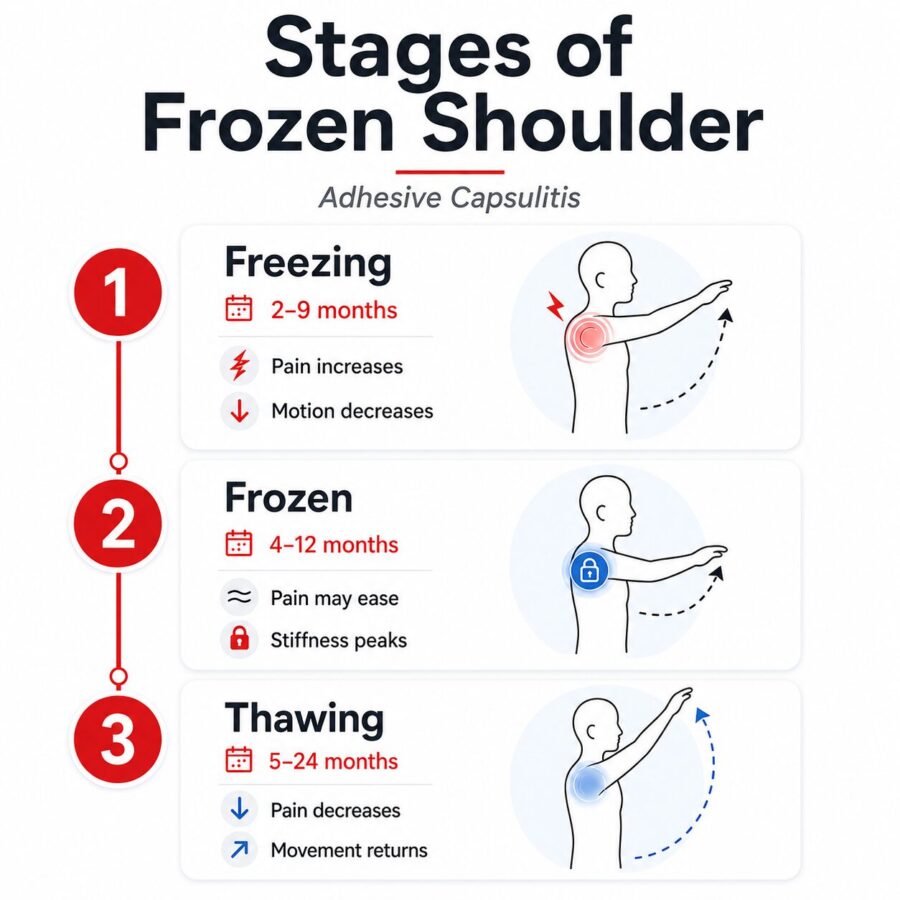
Frozen shoulder typically progresses through three stages. The timing varies, but each stage tends to have a different mix of pain and stiffness:
- Stage 1: Freezing: Pain increases while shoulder movement gradually becomes more limited. Night pain is common, and reaching or sudden movements may be especially uncomfortable. 2 to 9 Months.
- The frozen phase: The shoulder may become less painful even though it remains markedly restricted. Daily tasks are often limited more by stiffness than by discomfort at this point. 4 to 12 Months.
- The thawing phase: Shoulder movement gradually improves, and everyday activities become easier as pain decreases and mobility returns. 5 to 24 Months.
Those time ranges describe common patterns, not a schedule every shoulder must follow. Some people progress faster. Physical therapy in Defiance, MO can be adjusted throughout the process so treatment continues addressing the limitations that are most relevant at each stage.
How Is Frozen Shoulder Diagnosed in Defiance, MO?
Your provider will usually start by asking what you have been feeling, how long the shoulder has been stiff or painful, and whether anything happened before symptoms began. A physical examination follows.
A Defiance, MO provider evaluating a stiff shoulder is looking for a pattern, not simply one painful motion. They may compare multiple directions of movement, assess strength and posture, and determine whether passive motion is restricted along with active motion.
Imaging is not always necessary to diagnose frozen shoulder. X-rays, MRI, or ultrasound may be used when your provider needs to rule out another source of pain or stiffness, such as arthritis or a rotator cuff injury.
Frozen Shoulder Rehabilitation in Defiance, MO
Frozen shoulder rehab is not about forcing the joint through the same routine at every visit. The challenge is to work within what the shoulder currently tolerates while steadily building toward better mobility and function.
Your Defiance, MO Axes physical therapist can change the emphasis of treatment as the shoulder changes. A highly painful shoulder may need gentle movement and symptom management. A less painful but very stiff shoulder may tolerate more mobility work. Later, strengthening and normal movement patterns may become the focus.
Working With Pain During the Freezing Stage
Your initial program may use strategies such as:
- Gentle range-of-motion exercises
- Manual treatment from your physical therapist
- Activity modifications
- Ways to preserve useful arm movement without causing repeated symptom flares
Your Defiance, MO physical therapist may also help with sleeping positions, work tasks, exercise modifications, and other everyday movements that have become uncomfortable.
Improving Range of Motion as Pain Settles
When the shoulder is less painful, mobility work can take on a larger role. Your therapist may use a combination of specific stretches, active mobility exercises, and manual therapy to work on the directions that remain limited. A few additional degrees of movement can sometimes make dressing, grooming, or reaching considerably easier.
Restoring Strength as Motion Returns
As mobility returns, strengthening may focus on the rotator cuff, shoulder blade muscles, upper back, and other muscles that support normal arm movement. Resistance and exercise difficulty can increase gradually as your shoulder becomes more comfortable and capable.
Correcting Compensatory Movement Patterns
Improving shoulder range is useful, but it does not automatically eliminate compensations developed during months of stiffness. Your therapist may also work on the relationship between the shoulder blade, upper back, neck, trunk, and arm so movement becomes more natural again.
Getting Back to the Activities Frozen Shoulder Interrupted
The final stage is not simply about achieving a number on a range-of-motion test. It is about making the shoulder useful again. That may mean lifting at work, pressing weights overhead, swinging a golf club, throwing, gardening, or performing repetitive job tasks. Therapy can be tailored toward those demands.
Why Choose Axes Physical Therapy for Frozen Shoulder Treatment in Defiance, MO?
You cannot rush every stage of frozen shoulder, but you can still be active about recovery. The right plan can help you protect an irritable shoulder, address stiffness when it becomes appropriate, and rebuild function as movement returns.
Axes Physical Therapy in Defiance, MO does not approach every frozen shoulder the same way. Your program can be built around the stage you are in, the movements you have lost, the amount of pain you are experiencing, and what you need the shoulder to do again.
Individualized care: Your program is adjusted as pain, mobility, strength, and function change.
Care matched to the shoulder’s current tolerance: Treatment intensity can progress with your shoulder instead of forcing the same exercises from beginning to end.
Prompt access to care: Axes can typically schedule new patients in Defiance, MO within 24 to 48 hours of initial outreach.
Guidance on whether you need a referral: Axes can help you understand whether you can begin physical therapy in Defiance, MO without a physician referral based on your location and individual situation.
Coordinated care: If your examination suggests you need imaging, an injection, an orthopedic consultation, or another type of medical care, Axes can help you determine the appropriate next step.
Free injury screenings: You do not need to know exactly what is wrong before contacting Axes. A free injury screening can be a simple starting point if you are unsure whether your symptoms sound like frozen shoulder or something else.
Frozen Shoulder Treatment FAQs in Defiance, MO
Is physical therapy good for frozen shoulder?
Physical therapy is one of the main nonsurgical approaches used for frozen shoulder. Depending on your stage, the emphasis may be pain management, preserving movement, regaining mobility, rebuilding strength, or returning to normal activity. The program should evolve instead of remaining identical throughout recovery.
How can I recover from frozen shoulder faster?
The fastest route is not necessarily the most aggressive route. Early treatment may be about controlling irritation and maintaining useful movement, while later treatment can work more directly on stiffness and strength. Trying to force motion before the shoulder can tolerate it may backfire.
How much should I stretch a frozen shoulder?
Yes, stretching is commonly part of treatment. The important question is how hard, how often, and in which direction. Those decisions should reflect your current pain level and stage of recovery rather than a one-size-fits-all rule.
Will frozen shoulder eventually improve?
The natural course of frozen shoulder generally trends toward improvement, but recovery can take months. Physical therapy can help make that period more manageable while working toward better movement and normal activity.
Are there movements I should avoid with frozen shoulder?
Avoid turning your rehabilitation into a contest to see how much pain you can tolerate. Exercises or stretches that cause substantial or lasting increases in pain may be too aggressive for your current stage. Your physical therapist can help determine which movements are appropriate and when to progress them.
Can frozen shoulder affect the other shoulder later?
It is relatively uncommon for the same shoulder to go through another full episode of frozen shoulder. However, some people later develop adhesive capsulitis on the opposite side, particularly when other risk factors are present.
Will I need surgery for frozen shoulder?
For most patients, no. Frozen shoulder is usually managed without an operation. If the shoulder remains severely painful or restricted after an appropriate period of conservative care, an orthopedic specialist may discuss procedural or surgical options.
When should I see a physical therapist in Defiance, MO for shoulder stiffness?
Consider seeing a Defiance, MO physical therapist when stiffness is progressing rather than improving. Because rotator cuff problems, arthritis, and other conditions can also cause pain and restricted movement, an examination can help clarify what you are dealing with.
Get Help for Frozen Shoulder in Defiance, MO
Frozen shoulder can take time to improve, but you do not have to wait it out on your own. Physical therapy in Defiance, MO can help reduce pain, improve mobility and strength, and help you return to work, exercise, sports, and everyday activities as your shoulder recovers.
Your Axes program does not need to stay frozen just because your shoulder is. Treatment can keep evolving as pain, mobility, strength, and function change.
If shoulder pain and stiffness are limiting you, request an appointment, call your nearest Axes location, or come in for a free injury screening.