Runner’s Knee Pain Treatment Clearwater, MO. Patellofemoral pain syndrome (PFPS), commonly called runner’s knee, can make a familiar running routine suddenly feel unpredictable. You might take a few days off, ease back into a run, and still find yourself wondering whether you should keep going or call it early. For someone who runs regularly, that uncertainty can get old quickly. The discomfort can also follow you into the rest of your day, showing up when you use stairs, rise from a chair, squat, or spend time with your knee bent.
You don’t have to figure out persistent knee pain on your own. At Axes Physical Therapy, we help people in Clearwater, MO understand what may be contributing to their symptoms and what they can do about it. We’ll evaluate your movement, strength, and the way your knee responds to running-related activity, then develop an evidence-backed treatment plan built around helping you get back to running comfortably.
You can often start sooner than you might think. Direct Access Physical Therapy lets many Clearwater, MO patients start without a physician referral, and Axes can usually see you within 24–48 hours of contacting us. If your knee pain needs a doctor’s attention first, we can help connect you with someone in our network.
To get started, call the location nearest you, request an appointment online, or visit us for a free injury screening.
If your knee pain follows a sudden injury, causes severe swelling or visible deformity, or makes it difficult to move your knee or bear weight, seek medical evaluation promptly. A knee that locks or repeatedly gives way also needs evaluation. Seek urgent care if your knee is hot and red and you have a fever.
Here, you’ll learn about:
- Common runner’s knee symptoms and factors that may contribute to them
- Ways physical therapy may help improve strength, mobility, and the way you move while running
- What you can work on outside your appointments
- How you may progress toward running again
What Does Runner’s Knee Mean?
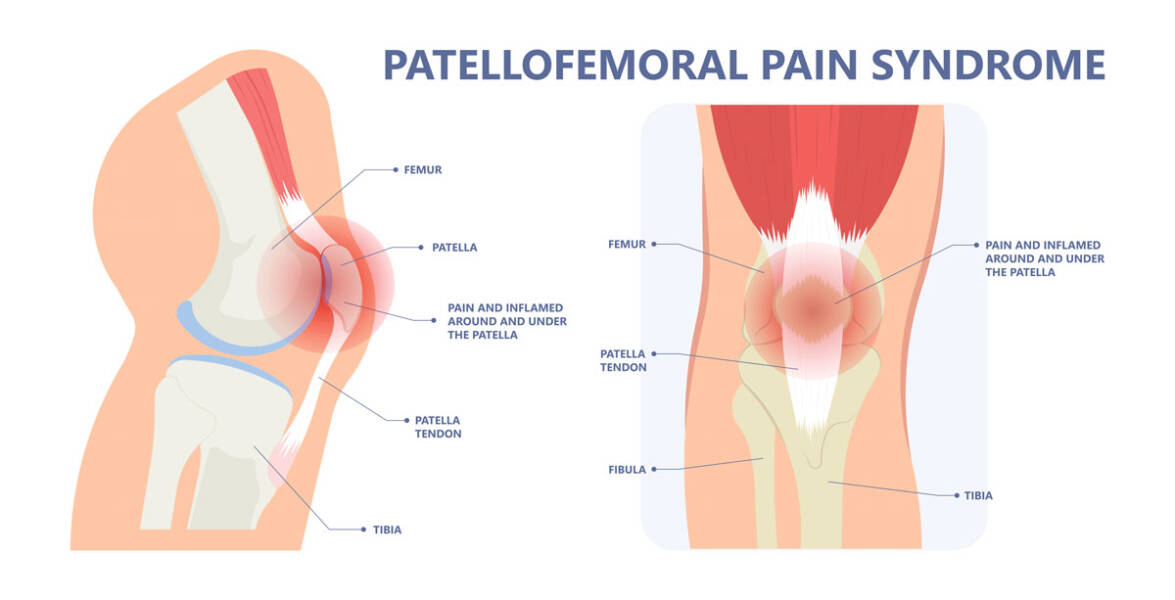
Patellofemoral pain syndrome, better known as runner’s knee, is pain that develops around or behind the patella (kneecap) as it moves against the femur (thighbone). You may notice it most during movements that place more demand on a bent knee, including running, going up or down stairs, and squatting.
Sometimes the issue is simply that the knee is being asked to handle more than it has adapted to. Increasing your training, changes in strength, and the mechanics of how your leg moves can each influence how much stress reaches the area around the kneecap.
Despite the name, you don’t have to be a runner in Clearwater, MO to develop runner’s knee. Climbing stairs, squatting, and other activities that repeatedly load a bent knee can bring on symptoms. Getting evaluated helps you avoid spending weeks treating the wrong problem.
What Runner’s Knee Can Feel Like
Runner’s knee does not always begin with constant pain. You might notice an ache late in a run that fades once you stop, only for it to return the next time you train. As symptoms progress, the pain may start sooner or show up during movements that used to feel completely normal.
Common symptoms include:
- Pain that feels centered around or behind the kneecap
- Discomfort when the knee is loaded during running, stair climbing, downhill walking, or squatting
- Aching after sitting for a while with the knee bent
- Tenderness around the kneecap
- A grinding or popping feeling during knee movement
What Causes Runner’s Knee Pain?
Runner’s knee often develops when the demands of training increase faster than your knee is ready to handle. Changes in strength, flexibility, and the way your leg moves can also influence how much stress reaches the area around the kneecap.
Possible contributors include:
- Overuse or sudden training changes. Repeated running and jumping stress the knee. Increasing distance, speed, and hills at the same time can be especially demanding.
- Not enough recovery time. Several demanding workouts in a row can leave your knee with little time to adapt, especially if your overall training volume is also going up.
- Weakness in the hips or thighs. Your quadriceps and hip muscles help control your leg during each step. If those muscles are not providing enough support, your knee may have to absorb more of the workload.
- Restricted mobility. When your hips, hamstrings, calves, or ankles do not move as freely as they should, your body may compensate elsewhere. That can change how force travels through the knee. Learn more about mobility.
- Foot mechanics or shoe support. Some runners may be affected by flat feet, inward rolling of the foot, or footwear that changes how forces move through the leg. These factors can be evaluated alongside your running mechanics.
- How your leg is aligned. The relationship between your hip, knee, kneecap, and foot can affect how pressure is distributed through the joint.
- Prior injury or surgery. Your knee’s history matters, too. A previous kneecap dislocation, cartilage injury, or certain surgeries may increase the likelihood of patellofemoral pain.
How Physical Therapy in Clearwater, MO Can Help With Runner’s Knee
At your first appointment, your Clearwater, MO physical therapist will start by learning more about your knee pain, your health history, and the activities you want to get back to. We’ll want to know when the pain started, whether you change the way you run because of it, and how the knee feels after activity or the next day. If you’re training for a race or working toward a specific date, let us know that too.
Part of the evaluation involves watching you move. Your Clearwater, MO physical therapist will test strength and flexibility and may ask you to squat, balance on one leg, step down, or perform similar movements. These tasks can show us where you are moving well and where your knee may need more support.
Then we’ll walk through the plan together. You should leave knowing what to work on, what to change for now, and what to watch for between visits. We’ll also coordinate with your Clearwater, MO doctor when appropriate and help arrange further evaluation if your symptoms call for it.
Hip and Quadriceps Strengthening
Your hip and thigh muscles work together to control your leg as you land, push off, and support your body weight. Building strength in these areas is an important part of treating runner’s knee.
Exercises may include:
- Side-lying leg raises, lateral band walks, or similar exercises for the muscles along the outside of your hip
- Glute bridges to work the muscles that help control your hips and pelvis
- Squats or sit-to-stands to practice supporting your weight as your knees bend
- Step-ups, step-downs, or similar single-leg tasks to improve strength and control
- Knee extensions to strengthen the quadriceps at the front of your thigh
The goal is not to force your knee through an exercise it is not ready for. If a deep squat increases your pain, we may shorten the range. If stepping down from a standard height is too demanding, we can lower the step and build from there.
As you get stronger, our Clearwater, MO physical therapists will adjust the resistance, repetitions, or difficulty. We’ll also explain how the exercise should feel so you know when to keep going and when to ask for an adjustment.
Improving Flexibility and Mobility
Your physical therapist in Clearwater, MO may find that stiffness in your calves, thighs, hips, or ankles is changing the way you move. Those findings help us choose stretches and mobility work that address your specific limitations rather than giving everyone the same routine.
We’ll guide you through stretches that target the areas that need attention while avoiding positions that unnecessarily aggravate your knee. In some cases, manual physical therapy techniques may also be used alongside your exercises to address stiffness.
Running Mechanics and Movement Retraining
Small changes in movement can sometimes reduce the strain you feel during running or other activities. Your Clearwater, MO physical therapist may observe your running form directly or use video motion analysis to examine your mechanics in more detail.
If your movement assessment points to something worth changing, we may experiment with your stride length, cadence, or other aspects of your running form and see whether your knee feels different. We can also practice better control during everyday tasks like stairs, squatting, or lowering yourself onto one leg.
You do not need to overhaul the way you run overnight. We’ll work on one useful change at a time, make sure it feels manageable, and build from there as your comfort and control improve.
Taping, Shoes, and Orthotic Support
Sometimes a temporary support can make activity more manageable while you work on the underlying problem. Your therapist may try patellar taping or a shoe insert, then compare how your knee feels during a movement that normally causes pain.
If you recently changed running shoes, make sure to mention it during your evaluation. Your therapist can talk with you about fit, comfort, support, and whether the change lines up with when your symptoms began. In many cases, runner’s knee can be treated without immediately investing in new footwear or custom inserts.
If a support makes movement more comfortable, we may use it temporarily while you work through your exercise program and build back toward your usual activities.
Training Adjustments and a Gradual Return to Running
If running is your time to clear your head, being told to cut back can be hard to hear. We’ll talk with you about what you can keep doing and what needs to change temporarily. That might mean shorter runs on flatter routes, a break from speed work, or another form of exercise while your knee settles down.
Once your knee is ready for more, we can help you choose a manageable starting point and build from there. That might mean a short continuous run or alternating periods of running and walking. We’ll pay attention not only to how you feel during the workout, but also to how your knee responds hours later and the next day.
A good short run is progress. Give yourself time to build on it before testing your old long-run distance.
At-Home Care for Runner’s Knee Pain in Clearwater, MO
To help manage symptoms between appointments:
- Scale back activities that aggravate your knee. You may need to reduce your running temporarily or avoid the workouts that consistently flare your symptoms. If it feels comfortable, swimming or another lower-impact activity can help you keep moving.
- Use ice if it helps with short-term comfort. Place a towel between your skin and the cold pack and leave it on for about 15–20 minutes at a time.
- Talk with your provider about compression and elevation. These strategies may help control swelling or improve comfort, but noticeable or unexplained swelling deserves medical attention.
- Ask before using medication for the pain. Your doctor or pharmacist can help you decide what is appropriate based on your health history and any other medications you take.
Measures such as rest, ice, compression, and elevation may help make your knee more comfortable, but they are only part of the picture. Keep following the rehabilitation plan from your Clearwater, MO physical therapist as well. A knee that feels better after icing is not automatically ready for a longer or harder run.
Do not struggle through a home program that is not working for you. If time, equipment, discomfort, or anything else is getting in the way, bring it up with us. We can modify the exercises so the plan better fits your day and your current abilities.
What Is the Recovery Timeline for Runner’s Knee?
It’s reasonable to want a date when you can run normally again. We’ll give you our best guidance after evaluating your knee, but there isn’t a reliable shortcut or one recovery schedule that fits everyone.
Some people notice their symptoms settle relatively quickly after adjusting their training, even though rebuilding tolerance for regular running takes longer. Longer-standing runner’s knee may need a more gradual rehabilitation process over several months.
Progress is not measured only by whether you can complete your old running distance. We may look for things like easier stair use, better control during an exercise that was difficult at first, or a short run that does not leave your knee feeling worse later. Those improvements help guide the next step.
If you’re putting in the work and not improving, we’ll revisit the plan and involve your Clearwater, MO doctor if further evaluation is needed. Before you finish therapy, we’ll also discuss which exercises to continue and how to approach future increases in training.
Clearwater, MO Runner’s Knee Pain Treatment FAQs
Should I Stop Running if I Have Runner’s Knee?
Having runner’s knee does not automatically mean every run is off-limits. Depending on your symptoms, you may be able to continue with easier or shorter runs in Clearwater, MO. If you are limping, progressively hurting more, or paying for the run later that day or the next morning, your current workload may be too much. A therapist can help you decide what to modify.
Will Runner’s Knee Go Away With Rest Alone?
Rest can help the pain settle, but it may return when you start running again. If you keep repeating that cycle, an evaluation can help identify what else needs attention, such as strength, movement, or your training volume.
Are There Exercises I Should Avoid With Runner’s Knee?
For now, modify exercises that aggravate your knee. That may include deep squats, jumping, or repeated stair climbing. It doesn’t mean those movements are off-limits forever. Your therapist can help you find an easier version and work back toward them.
Do I Need a Referral to Start Physical Therapy for Runner’s Knee?
In many cases, people in Clearwater, MO can start physical therapy for runner’s knee through Direct Access without first obtaining a referral. If you are unsure what your insurance requires, call Axes. We can help you sort out the details and determine the quickest appropriate way to get started.
Start Physical Therapy for Runner’s Knee in Clearwater, MO
When knee pain keeps interrupting your runs or everyday activity, getting evaluated can help you stop guessing about what to do next. We’ll listen to your concerns, look at what may be contributing to the problem, and work with you and your doctor toward the activities that matter to you.
Axes can usually schedule your first appointment within 24–48 hours of contacting us. If you need a different type of care first, we can help connect you with an appropriate provider in our network.
Take the next step by contacting your nearest Axes location, requesting an appointment online, or coming in for a free injury screening.