MCL Injury | Dittmer, MO Physical Therapy
MCL Injury in Dittmer, MO. For many athletes and physically active people, feeling that sudden “pop” in their knee creates a lot of anxiety: Did I suffer an MCL injury? Is it significant? How long will it take to recover? Will I have to permanently give up the things I love doing? At Axes Physical Therapy in Dittmer, MO, all of our physical and occupational therapists are dedicated to getting our clients back to sprinting down the court. While we’d like to be able to magically fix your MCL, we can help ensure you get back to feeling like yourself with safe, effective treatments. Physical therapy has proven to be a fundamental component of recovering from any MCL injury. Our physical therapists in Dittmer, MO are movement health experts. For lasting and meaningful recovery, reach out to the Axes location most convenient for you you or contact us online.
The Anatomy of the MCL
MCL is an abbreviation for “medial collateral ligament.” A ligament is like a strong, firmly attached rope that connects bone to bone and helps hold structures with the body together. The MCL runs from the inside of your upper shin bone to the inside of your bottoms thigh bone and keeps the knee from moving side to side. Its functions to resist valgus stress, or the knee being forced too far towards the other one. It combines with three other ligaments that work together to support normal function and stability:
- ACL (anterior cruciate ligament), which runs down the center of your knee and provides rotational stability and controls forward movement
- PCL (posterior cruciate ligament), which crosses the ACL in the middle of the knee and prevents excessive posterior translation of the tibia relative to the femur
- LCL (lateral collateral ligament), which connects the femur to the fibula (the smaller bone between the knee and ankle) and helps keep the outer side of your knee joint stable
The knee is known for being one of our most complex joints. Correct structure and function depends on surrounding bone, muscle, tendons, and ligaments. When any knee injury, such as an MCL tear, occurs it can greatly affect your mobility and compete like you’re used to, or just get around the house pain-free. Particular physical therapy techniques and other physician-prescribed treatment plans have been demonstrated through research and analysis to help those who have suffered an MCL injury manage their symptoms and get back to optimal mobility.

What Types of MCL Injuries Are There?
In general, an MCL injury either involves a sprain, wherein the MCL is stretched beyond its normal range of motion, or a tear, where the ligament is either partially or completely torn or separated from the bone. There are three grades to MCL injuries:
- Grade 1 — A grade 1 sprain or tear means that the ligament has been stretched, and less than 10% of the the fibers in your MCL are torn. It’s typically a mild injury, and your knee largely remains stable. Your knee will feel tender, and you may also experience mild pain.
- Grade 2 — This injury is when the MCL suffers more significant tearing, usually to the middle layer of the ligament. You will probably lose some stability in the joint, and the knee will likely be loose when manipulated manually. A grade 2 injury will result in significantly more pain than a grade 2 MCL injury.
- Grade 3 — A grade 3 tear is a complete tear, or separation from the bone. You will likely feel like your knee’s about to buckle. You will likely experience significant pain and a wide array of symptoms. The injury may actually caused by or accompanied by other serious knee injuries such as ACL tears.
However significant your MCL injuries, our expert Dittmer, MO physical and occupational therapists at Axes can, as a team with your physician, develop an extensive and customized plan to get you back to the things you love in a safe and effective manner.
What Causes MCL Injuries?
Ligament injuries account for 40% of all knee injuries, and the MCL is the most commonly injured ligament. MCL injuries occur due to the knee suddenly being forced too far inward. MCL injuries can also occur if the knee is rotated too forcefully. They can also occur because of landing or unnatural bending, such as if a cleat is stuck in grass while your leg keeps moving.
Athletes in contact sports are the most likely to sustain an MCL injury. They can also occur in people who lift weights or lift heavy objects at their work.
Common Symptoms of MCL Injuries
Most MCL injuries are accompanied by sudden, noticeable pain. Other symptoms may include:
- A sudden “pop” on the inside of your knee
- The knee being unstable
- Inability to bear weight
- Bruising
- Tenderness along the inside of the joint
- Inflammation, either on the inside of the knee or the entire knee joint
Sometimes your knee may feel like it’s wobbling when you walk, even if walking doesn’t hurt, or in other cases the knee feels too rigid. Any time you feel pain or instability in your knee, stop any strenuous activity immediately and schedule a physical examination in order to get a diagnosis.
Diagnosis and Treatment of an MCL Injury in Dittmer, MO
Diagnosing an MCL injury requires going to a physical examination. The examination will usually start with a doctor or physical therapist in Dittmer, MO asking how the injury occurred. They’ll then bend your knee and apply slight pressure to the outside of it, noting your pain level and if your knee feels structurally sound. They’ll also gently feel for swelling, and may compare your injured knee to the healthy one.
Most physical therapists or physicians that specialize in mobility of the human body in Dittmer, MO will be able to diagnose an MCL injury with the above procedures. Other tests to check severity or to confirm may include:
- An MRI (magnetic resonance imaging), which uses a magnetic field and radio waves to take detailed images of your soft tissue
- An ultrasound, which uses sound waves and can be helpful in checking the severity of your injury
- An X-ray, which does not show soft tissue, may be ordered for a severe MCL injury to ensure there are no broken bones
Axes Physical Therapy also offers injury screening injury screenings at no cost or obligation to you. While we can offer you an evaluation, Missouri Revised Statute §334.506 stipulates that physical therapy be prescribed by a doctor.
How to Treat and MCL Injury in Dittmer, MO
Right after your MCL injury, you should start with basic first aid: reducing swelling, easing pain, and utilizing the R.I.C.E. Method of Rest, Ice, Compression, and Elevation. For sprains or slight tears, the R.I.C.E method, over-the-counter pain relievers, and a few days or week or two of rest may be enough for your body to heal itself.
Professional physical therapy is needed for more severe injuries to restore strength and optimal range of motion and get you back to the activities you love. You’ll also need time off your feet to allow your body to heal safely. Your Axes physical therapist in Dittmer, MO can fit you for a knee brace in order to prevent your knee from bending too far inward while your MCL is still healing. With physical therapy, you’ll still continue icing your knee and taking anti-inflammatory pain medication.
Surgery is typically only needed with severe grade 1 MCL injuries, or if the MCL tear is accompanied by an ACL tear or other damage to the structures of the knee. The surgery is performed by using a graft, either from one of your other ligaments or from another person, to reconstruct the MCL. The surgery is an outpatient procedure. If you do require surgery in Dittmer, MO, our physical therapists are experts at pre- and post-surgical rehabilitation to make your surgery and recovery as successful as possible.
How Do Physical Therapists in Dittmer, MO Treat MCL Injuries?
The objective of physical therapy, when dealing with any injury, is to design safe, effective, and evidence-backed treatment methods based on each patient as an individual. Physical therapy slowly and effectively improves strength in the strength in the muscles that power the joint, flexibility of soft tissue, and range of motion to the knee in the interest of not only recovery, but injury prevention. Depending on you and your injuries, your treatment plan may include:
- To begin, light motions performed by your physical therapist to slowly get the ligament used to normal motion again
- More active exercises and stretches later to further develop strength and flexibility
- Exercises with resistant bands, weight lifting equipment, or cardio machines such as an elliptical
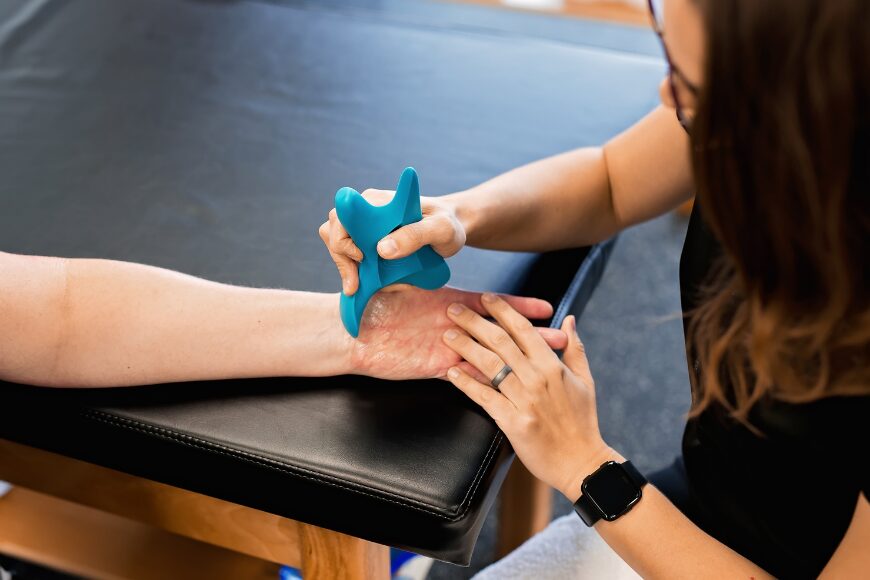
- Instrument-assisted soft tissue mobilization, which studies show can accelerate knee ligament healing
- Kinesio Taping®, which keeps the knee stable and helps control motion
- Trigger point dry needling to further help the body’s natural healing process
- Blood flow restriction training to improve strength while lessening stress on the joint
- Athletic training and sports therapy for those whose main goal is to get back onto the court or field
At Axes Physical Therapy in Dittmer, MO, all of our treatment plans are as unique as each patient, and created with the help of your physician, in order to get you the best patient outcome possible and get you back to the activities you love.
Other services we offer in Dittmer, MO include:
- Runner's Knee Pain Treatment
- Frozen Shoulder Treatment
- Golfer's Elbow Treatment
- Trigger Finger Treatment
- Shoulder Pain Treatment
- Back Pain Treatment
- Neck Pain Treatment
- Physical Therapy Clinic
- Carpal Tunnel Syndrome Treatment
- Sciatica Treatment

Call an Axes Physical Therapist in Dittmer, MO for Your MCL Injury
An MCL injury can be painful and frightening, especially if you’re an athlete or someone who finds joy in an active lifestyle, but with our help, you can get back to how you used to feel. We know our clients trust us with their recovery, so we repay that trust with safe and effective treatments that are backed by evidence. As part of our program, we’ll educate you on your injury and the structures of the knee so you can stay as healthy and active as possible. For meaningful and lasting recovery from your MCL injury in Dittmer, MO, call the location nearest you and request an appointment online.