Even simple parts of your day can feel harder than they should when neck pain is involved.
You might notice it first thing in the morning, feel it gradually worsen throughout the day, or trigger it when turning your head, driving, sleeping, or using a screen. For some people, it starts suddenly after an injury; for others, it develops slowly and sticks around.
A major source of frustration with neck pain is not knowing what’s actually causing it or what the next step should be.
At Axes Physical Therapy in Swansea, IL, we work to identify what’s going on early, so you’re not left guessing or trying solutions that may not help. Once we understand what’s going on, we guide you through a treatment plan focused on reducing pain, restoring mobility, and helping you return to your routine with more confidence.
In many cases, you can start care with Axes without a prescription or referral and be scheduled within 24 to 48 hours. To begin physical therapy for neck pain, you can call the location nearest you, request an appointment online, or visit one of our locations for a free injury screening.
Benefits of Physical Therapy for Neck Pain in Swansea, IL
Pain relief may be the first goal that comes to mind, but effective physical therapy for neck pain focuses on more than just reducing pain.
With physical therapy, patients often work to:
- improve neck mobility so you can move freely and comfortably again
- increase strength and stability to reinforce proper posture and movement
- help reduce stiffness, muscle tension, and ongoing daily discomfort
- decrease headaches related to neck issues
- complete everyday activities without ongoing discomfort or restriction
- get back to work, exercise, driving, and your normal routine
- reduce the likelihood of future flare-ups
For every patient we see in Swansea, IL, the goal remains consistent: to help you safely and efficiently return to the activities you enjoy most.
Understanding the Causes of Neck Pain
Neck pain affects a large number of people, with roughly 10% to 20% of adults experiencing it. It tends to occur more frequently in women, and the chances of experiencing it increase with age.
There are many potential causes of neck pain, including muscle strain, poor posture, injuries, and underlying spinal issues.
For some, it starts with a specific event; for others, it builds over time.
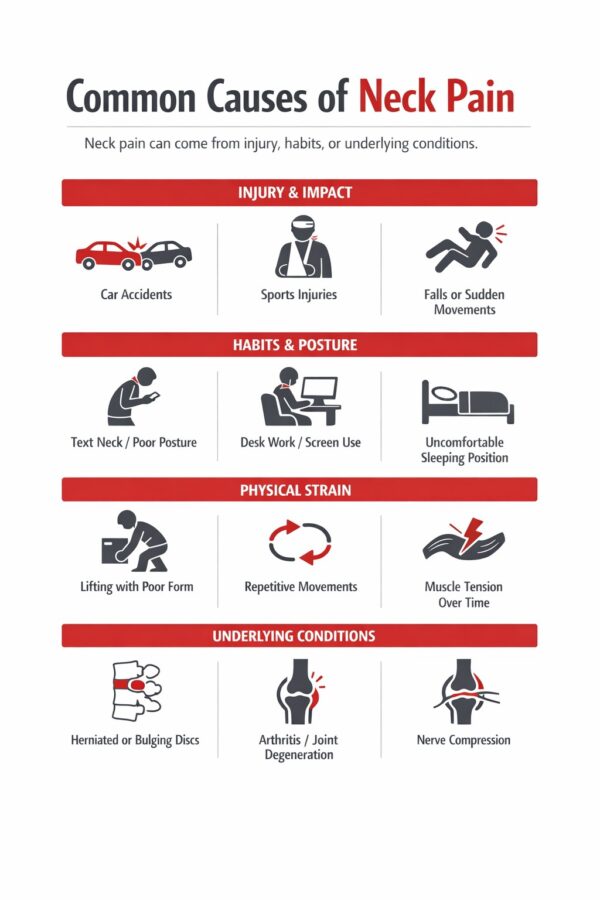
Common contributing factors to neck pain include:
- auto accidents, including whiplash
- impact-related injuries, including sports injuries
- sudden movements or falls
- lifting objects with poor form or in an awkward way
- sleeping in positions that strain the neck
- poor posture, especially from desk work or phone use (“text neck“)
- repetitive movements or overuse
- gradual muscle strain or tension buildup
- stress-induced tightness in the neck and shoulders
- conditions like herniated or bulging discs affecting the cervical spine
- joint-related issues like stiffness or degeneration (arthritis)
- compression or irritation of nerves
- movement limitations or underlying mobility issues
Identifying the cause is important because effective treatment focuses on the underlying issue.
Signs and Symptoms of Neck Pain
Neck pain does not feel the same for everyone, and it can show up in a variety of ways, including:
- an ongoing ache that does not go away
- a sharp or stabbing pain, sometimes accompanied by a burning sensation
- pain that radiates into the shoulders or arms
- headaches that occur often, including tension headaches
- noticeable stiffness affecting the neck, shoulders, or upper back
- trouble turning your head or looking from side to side
- a numb or tingling sensation
- a pins-and-needles feeling in the shoulders or arms
- episodes of muscle tightness or spasms
Treatment Options for Neck Pain in Swansea, IL
In some cases, depending on the cause and severity, neck pain can be managed with simple at-home approaches.
Short-Term Neck Pain Relief
Short-term relief methods often include:
- rest, ice or heat, and adjusting your activity level
- heat therapy
- non-prescription pain relievers
- self-directed stretching
- allowing time to see if symptoms resolve
Although these steps can offer temporary relief and help manage symptoms, they do not always correct the underlying issue causing your neck pain.
Situations That May Require Advanced Care
While many cases of neck pain respond well to basic treatment, some situations require specific care, such as imaging, prescribed medication, injections, or evaluation by a specialist. Recognizing when advanced care is needed can help you avoid delays in proper treatment.
You may need more advanced evaluation or treatment if you are experiencing:
- Persistent and worsening pain
Pain that does not improve with rest or continues to intensify over time - Radiating neurological symptoms
Pain, numbness, tingling, or weakness that travels into the shoulder, arm, or hand, which may suggest nerve involvement (such as a herniated disc) - Loss of strength or coordination
Difficulty with grip strength, lifting your arm, or maintaining normal function - Restricted movement that does not improve
Persistent stiffness or inability to turn or move your head normally - Pain after trauma or injury
Injuries such as car accidents, falls, or sports-related incidents that may require imaging to assess structural damage - Ongoing symptoms that fail to improve
Pain that continues for several weeks despite rest or basic treatment - Indicators of a more complex condition
Such as advanced arthritis, disc degeneration, or spinal instability
If you have severe symptoms after trauma, new numbness or weakness, or symptoms that are rapidly worsening, seek medical evaluation promptly.
When you’re not sure what level of neck pain treatment you need, physical therapy can clarify the next steps. A physical therapist in Swansea, IL can evaluate your symptoms, identify what treatment may be appropriate, and guide you toward the right next step if additional care is needed.
Why Physical Therapy in Swansea, IL Should Be Your First Step for Neck Pain Treatment
Many people assume physical therapy comes later in the recovery process, but in many cases, it is actually the best place to begin.
Here’s what makes it effective:
Access Physical Therapy Without a Prescription
In the past, Missouri law required a prescription from a medical doctor before beginning physical therapy. However, with the availability of direct access physical therapy, many individuals can now begin care without needing a prescription.
Without that barrier, patients can respond more quickly when symptoms first develop.
Fast Scheduling for Neck Pain Care
In many cases, Axes can schedule patients within 24 to 48 hours after they reach out.
For someone experiencing neck pain, this quick scheduling can make a meaningful difference compared to waiting several weeks for care. Instead of waiting for one appointment, then a referral to a specialist or follow-up, you can get answers and begin care much sooner.
Understand Your Injury Sooner
Physical therapists are trained to identify what’s actually causing your neck pain and how it’s affecting your movement.
During your first appointment, your physical therapist will typically:
- Evaluate your pain and symptoms
- Evaluate your movement, posture, and mobility
- Identify any functional limitations affecting daily activities
- Help determine if physical therapy is the right next step
- Initiate treatment during the visit when appropriate
- Recommend next steps or refer you to a specialist if needed
For many individuals, physical therapy provides a practical and confidence-building place to begin treatment.
What Neck Pain Treatment at Axes in Swansea, IL Looks Like
It is common to picture physical therapy as a set of simple stretches, a generic exercise sheet, and light resistance training from a standard routine.
Instead, Axes focuses on evidence-based treatment, hands-on care, and individualized plans that address the root cause of neck pain and help create meaningful, lasting outcomes.
It Begins With Identifying the Cause
Your initial visit focuses on determining the underlying cause of your neck pain.
This includes evaluating how your neck moves, where symptoms occur, and whether the issue remains localized or spreads into the shoulder or arm.
Treatment Adapts as You Improve
As pain levels decrease and mobility improves, your care plan evolves to keep pace with your recovery. What you focus on at the beginning of treatment will change as you progress over time.
In the early stages, treatment often focuses on reducing pain and restoring basic movement. Over time, treatment transitions into building strength, enhancing stability, and improving movement patterns.
This progression helps ensure you are not just feeling better temporarily, but working toward meaningful, lasting relief.
Treatment Supports Your Everyday Activities
Your Swansea, IL physical therapist helps improve movement during work, supports more comfortable sleep, and makes daily tasks easier to manage without constant irritation.
That may include adjusting how you sit at your desk, how you position your body while driving, or how you move during everyday tasks. These types of small adjustments can have a noticeable impact on your daily comfort.
Clear Guidance Throughout Your Recovery
At every stage of treatment, you will know what you are working toward, what progress looks like, and what the next step is. If physical therapy is the right fit, your plan is clear. If it is not, your therapist can help guide you to the right provider.
Physical Therapy for Neck Pain in Swansea, IL
Physical therapy for neck pain in Swansea, IL involves more than a single treatment. Treatment is built from a combination of techniques customized to your condition, symptoms, and goals.
At Axes in Swansea, IL, treatment may include:
Manual Therapy
Hands-on therapy is an essential component of treating neck pain.
This may include:
- joint mobilization to restore movement in the cervical spine
- soft tissue mobilization to reduce muscle tension and restriction
- trigger point treatment to address localized pain
These approaches are designed to reduce stiffness, improve mobility, and support more comfortable movement.
Targeted Strengthening and Exercise
Exercise plays a key role in addressing the underlying causes of pain.
This can include:
- targeted strengthening of deep neck flexors for stability
- targeted scapular strengthening for postural support
- improving mobility in the neck and upper back
- nerve glides to address radiating symptoms
- functional movement training for daily activities
Programs evolve as you improve to support recovery and reduce the chance of recurrence.
Spine Specialty Care
As part of our spine specialty services, care is designed for conditions such as:
- issues involving herniated or bulging discs
- nerve compression or irritation
- degeneration within the cervical spine
This approach allows for more precise, condition-specific treatment when symptoms are more complex.
Trigger Point Therapy With Dry Needling
In some cases, dry needling may be used to:
- address tight muscle bands
- relieve pain
- support improved mobility
This approach can be particularly effective for ongoing muscle tension and referred pain patterns.
IASTM (Instrument Assisted Soft Tissue Mobilization)
Therapists use specialized soft tissue mobilization tools to:
- target and reduce scar tissue and adhesions
- improve blood flow
- support the healing process
Kinesio Taping® Techniques
Kinesio taping can be used to:
- provide support to muscles and joints
- decrease strain
- enhance overall movement patterns
Posture & Movement Retraining
Neck pain is often linked to everyday habits.
Treatment often includes:
- workstation and ergonomic adjustments
- postural correction strategies
- movement pattern retraining
This approach helps minimize ongoing strain during daily activities.
Rehabilitation Before and After Surgery
If surgery is required, physical therapy plays a key role before and after the procedure.
- Pre-surgical therapy is designed to build strength and mobility before surgery to support better recovery.
- Post-surgical rehabilitation focuses on restoring movement, rebuilding strength, and safely returning to normal activity.
Vestibular Therapy When Needed
If neck pain is accompanied by dizziness, balance issues, or vertigo, vestibular therapy techniques may be used to address these symptoms.
This approach focuses on improving balance, coordination, and your body’s response to movement. This can reduce dizziness and improve overall stability during everyday movement.
Blood Flow Restriction (BFR) Training
Treatment may include blood flow restriction training (BFR) to:
- increase strength while minimizing risk
- reduce strain on healing tissues
- aid recovery when heavier loading is not appropriate
Start Your Neck Pain Treatment in Swansea, IL Today
If neck pain is an issue, you do not need to spend weeks wondering whether to wait, call your doctor, or attempt to handle it on your own.
At Axes Physical Therapy in Swansea, IL, most patients can be scheduled within 24 to 48 hours. Even if physical therapy is not the best option, you can be guided toward the right provider rather than left unsure of what to do next.
If neck pain is limiting your comfort, disrupting your routine, or making daily activities more difficult, Axes Physical Therapy can help you move forward with less uncertainty and more confidence.
For neck pain treatment in Swansea, IL, you can call the location nearest you, request an appointment online, or come to any of our locations for a free injury screening to get started.