Shoulder Pain in Dittmer, MO. If you live with shoulder pain, you know the limitations it can place on your life. It makes any basic task from brushing your teeth to playing volleyball frustrating and, sometimes, unfeasible. But you do not need to live the rest of your life with pain and limited shoulder movement. At Axes Physical Therapy in Dittmer, MO, our licensed physical therapists specialize in tailored treatment plans, based on evidence, to get you back to striking out opponents, or just combing your hair pain-free. Let us help you make your shoulder pain an ancient memory. Request an appointment through our website or find our location most convenient for you.
How Does the Shoulder Work? | Shoulder Pain in Dittmer, MO
The shoulder is one of the human body’s largest and most intricate joints. In actuality, what we call the shoulder joint is made up of four different joints:
- The glenohumeral (GH) joint is a ball and socket joint where the humerus (upper arm bone) fits into the socket of the glenoid. Given the relatively shallow dish, it allows for more movement than any other joint.
- The acromioclavicular (AC) joint connects the collarbone to the acromion, the bony tip on the outer edge of the shoulder blade. A plane joint, it allows you to outstretch your arm.
- The sternoclavicular (SC) joint is a gliding joint located where the collarbone meets the breastbone at the base of the neck. This joint is where the arm and body meet, it it ensures your arm and body act in tandem.
- The scapulothoracic (ST) “joint” is not a true anatomical joint as it does not have does not have union by fibrous, cartilaginous or synovial tissues. It is made up of the scapula and its articulation with the ribcage.
The shoulder is supported and surrounded by:
- the four muscles of the rotator cup covering the head of the upper arm bone, which are responsible for movement and keep the head of the humerus firmly within the shallow socket of the shoulder
- the shoulder capsule, a soft tissue sac that encloses the shoulder
- the four shoulder ligaments which provide passive stability while still allowing for movements in different planes
- the tendons in the biceps and shoulder which allow muscles to power the bones
- the brachial plexus nerves that allow for the brain and muscles to communicate with each other
- the arteries that pump much-needed blood to the shoulder
In order for the shoulder to function properly every joint, ligament, tendon, muscle, artery, capsule, and nerve must function well. Sufficient blood must flow to the shoulder efficiently to maintain healthy soft tissue and stimulate the body’s natural recovery processes. The muscles must have adequate strength and flexibility, the tendons attaching bone and muscle must be intact and strong, the ligaments that attach our bones need to be similarly healthy, and the nerves need to have a strong and secure connection to the brain. When any one of the parts of the shoulder is damaged, inflamed, or otherwise irritated, it often causes shoulder pain and movement problems. If if shoulder pain or poor shoulder movement is part of your daily life, contact Axes’ physical therapists for a no-risk, no-obligation injury screening.

What Causes Shoulder Pain?
As the shoulder is complex, shoulder pain can have many root causes, from sports injuries to acute trauma, a work injury from overuse to old age. The following are common causes of shoulder pain that our team see in Dittmer, MO:
- Bursitis — The bursae are small, fluid-filled sacs that act as shock absorbers and reduce friction in joints. Bursitis the result of the bursae becoming irritated after repeated activities, often occurs in association with rotator cuff tendinitis, and can make daily tasks like brushing your teeth exceedingly difficult.
- Tendinitis — Tendinitis is typically caused by a tendon becoming irritated. There are two types of tendinitis:
- Acute: This can happen because of trauma, excessive overhead motions, or other overhead activities common in some sports and occupations, such as throwing overhead or lifting boxes overhead.
- Chronic: The result of degenerative conditions or the body becoming weaker as we get older.
The condition causes pain and tenderness just outside the joint.
- Rotator Cuff Tear — These can also be caused by acute injuries, like lifting an incredibly heavy object, or wear and tear. The tendon is initially frayed before becoming torn. A partial thickness tear often goes unnoticed. Complete tears, where the tendon is completely detached from the bone, often require surgery. Symptoms include having difficulty raising your arm or lifting things you normally can, pain when lying on the side of the affected shoulder, and a clicking feeling with certain movements.
- Shoulder Impingement — Impingement describes when your acromion (outer edge of your shoulder blade) irritates the soft tissue in your shoulder. It often occurs alongside an injury that causes inflammation in the rotator cuff. Shoulder impingement is most common in people who play sports or are otherwise active.
- Shoulder Instability — This happens when the humerus is forced out of the shoulder socket, and also can happen suddenly or from overuse. Dislocations can be repeated and partial or the entire bone coming out of the socket. It often causes or is the result of injury to the supporting soft tissue of the shoulder. Chronic instability will cause shoulder pain and a sense of the shoulder “giving way.”
- Arthritis — While there are at least six types of arthritis, the shoulder most typically experiences osteoarthritis. It is the result of the cartilage cushioning the ends of your bones breaks down. It can be the result of tissue weakening as we become older, frequent injuries, and overuse. Arthritis cannot be cured, but effective pain management can be found with Dittmer, MO physical therapists.
- Shoulder Fractures — The upper arm bone, clavicle, and shoulder blade are the bones in the shoulder most susceptible to fracture. They usually happen as the result of falling a significant distance or onto a hard surface or forceful collisions such as being tackles in a football game. The shoulder pain is usually significant, and the shoulder will experience substantial swelling and bruising.
- Axillary Nerve Injuries or Brachial Plexus Injuries — Nerve damage in the shoulder is the result of when nerves are impinged on, when scar tissue interferes with their electric signals, or the nerves are otherwise damaged. These injuries can cause shoulder pain along with a range of other sensations. They are commonly caused by sudden trauma but can also occur because of degenerative conditions.
Sometimes, injuries are connected, such as a dislocation causing damage to the nerves. If you’re currently suffering from shoulder pain, one of our safe, free injury screenings in Dittmer, MO may help determine the underlying cause. To diagnose shoulder pain a physician in Dittmer, MO may use a physical examination, various imaging techniques, and/or arthroscopy. Most people who experience shoulder pain can experience relief with a customized treatment plan with knowledgeable physical therapists and movement health specialists in Dittmer, MO can be an effective way to return to the things you love to do the most.
How Do Dittmer, MO Physical Therapists Treat Shoulder Pain?
Your tailored and evidence-backed physical therapy treatments may include:
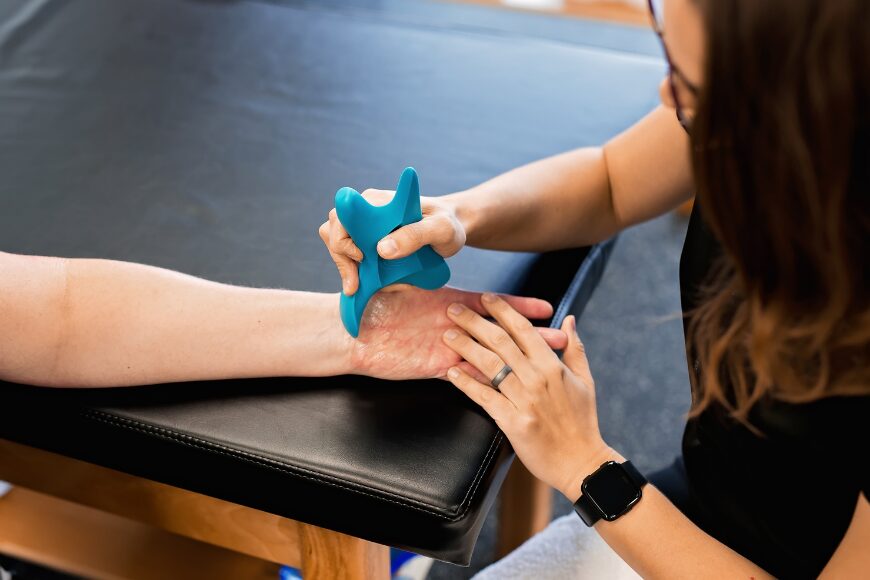
- Instrument-assisted soft tissue mobilization to detect and treat any soft tissue disorders
- Pre- and post-surgical rehabilitation, coordinated together with your surgeon, if your shoulder pain was caused by an injury that needed surgery to correct
- Kinesio Taping® to provide support for your shoulder and keep you safe as you participate in sports or go back to work while you are still recovering
- Blood flow restriction training to offer your shoulder a low-intensity exercise with high-intensity results
- Trigger point dry needling to attack harder-to-reach damaged muscles, ligaments, and tendons to encourage the body’s natural healing processes
- Posture correction to make sure you are not inadvertently causing your shoulder pain or heal improperly
- Injury prevention so you do not lose your active lifestyle in the future
- Other safe, effective treatment methods to increase and maintain your mobility
Missouri Law requires a prescription for physical therapy, so it’s necessary to speak to your Dittmer, MO doctor to see if physical therapy is safe and an effective treatment option for your shoulder pain. Our knowledgeable physical and occupational therapists form a team with your primary care physician to ensure you are getting the care that is safe for your condition.
Other services we offer in Dittmer, MO include:
- Frozen Shoulder Treatment
- Golfer's Elbow Treatment
- Trigger Finger Treatment
- Shoulder Pain Treatment
- Back Pain Treatment
- Neck Pain Treatment
- Physical Therapy Clinic
- Carpal Tunnel Syndrome Treatment
- Sciatica Treatment

Dittmer, MO Shoulder Pain | Axes Physical Therapy
Optimal movement health is important to not only carrying out daily tasks with ease, but to keeping up the active lifestyles we desire. At Axes, we focus on patient results for Dittmer, MO residents by creating evidence-backed treatment plans catered to your injury, pain level, age, and how physically active you need to be. You do not have to delay in getting back to the things you love doing most and a pain-free life. Make an appointment online or call our location nearest you.